Common Ground · Between Rain · Design Resolution
Testing the Canopy
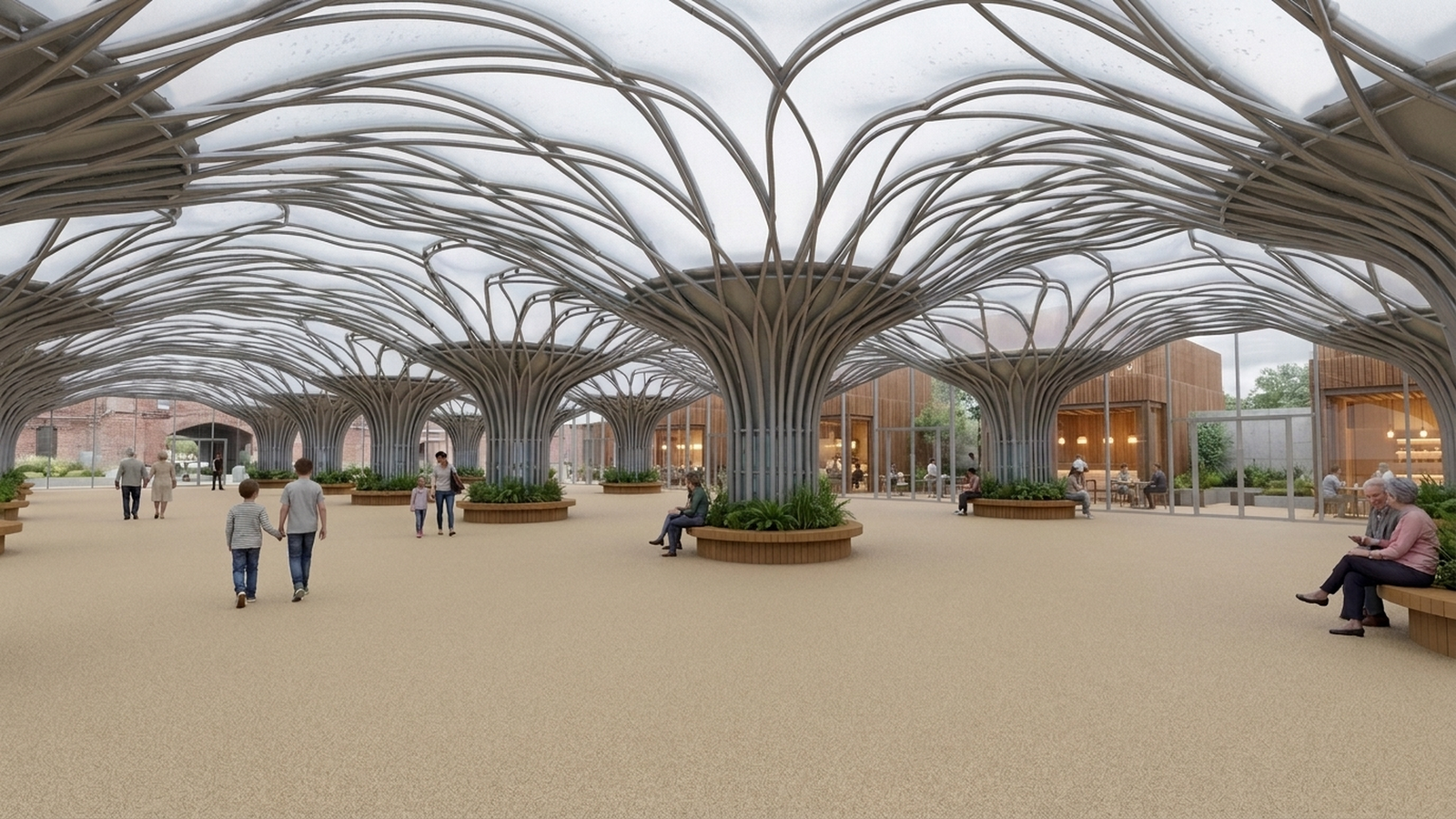
A rain-catching canopy for the Common Ground precinct. Funnel-shaped steel trees carry an ETFE skin, gather the rain and send it down glass downpipes inside each trunk to storage.
My role: designer, sole author. Methods: Rhino 8 and Grasshopper (parametric model), Karamba3D (structural check), Claude working through a Rhino connector at my direction, Nano Banana (one generation and one edit on the interior view).
On this page the drawings, diagrams and interior view are shown on the page colour: their white paper takes the page tone and every other colour is about 5% darker and warmer, legends included. Open any drawing, or the full sheets under Documentation, to see them exactly as issued.
 Testing the Canopy
Model and image
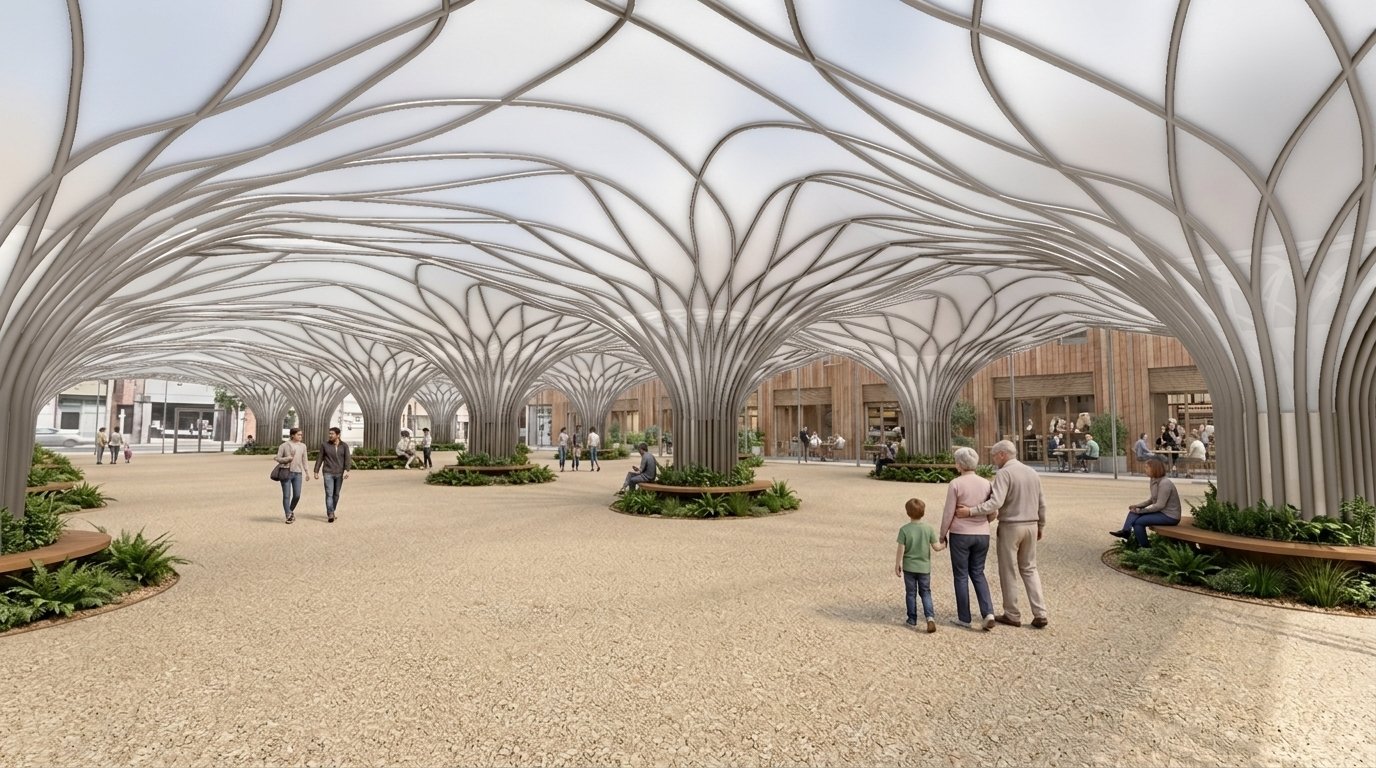
The interior view began as a view of the Rhino model. Nano Banana added materials, light, people and surroundings. The model view and the issued render are shown side by side so the change can be read.
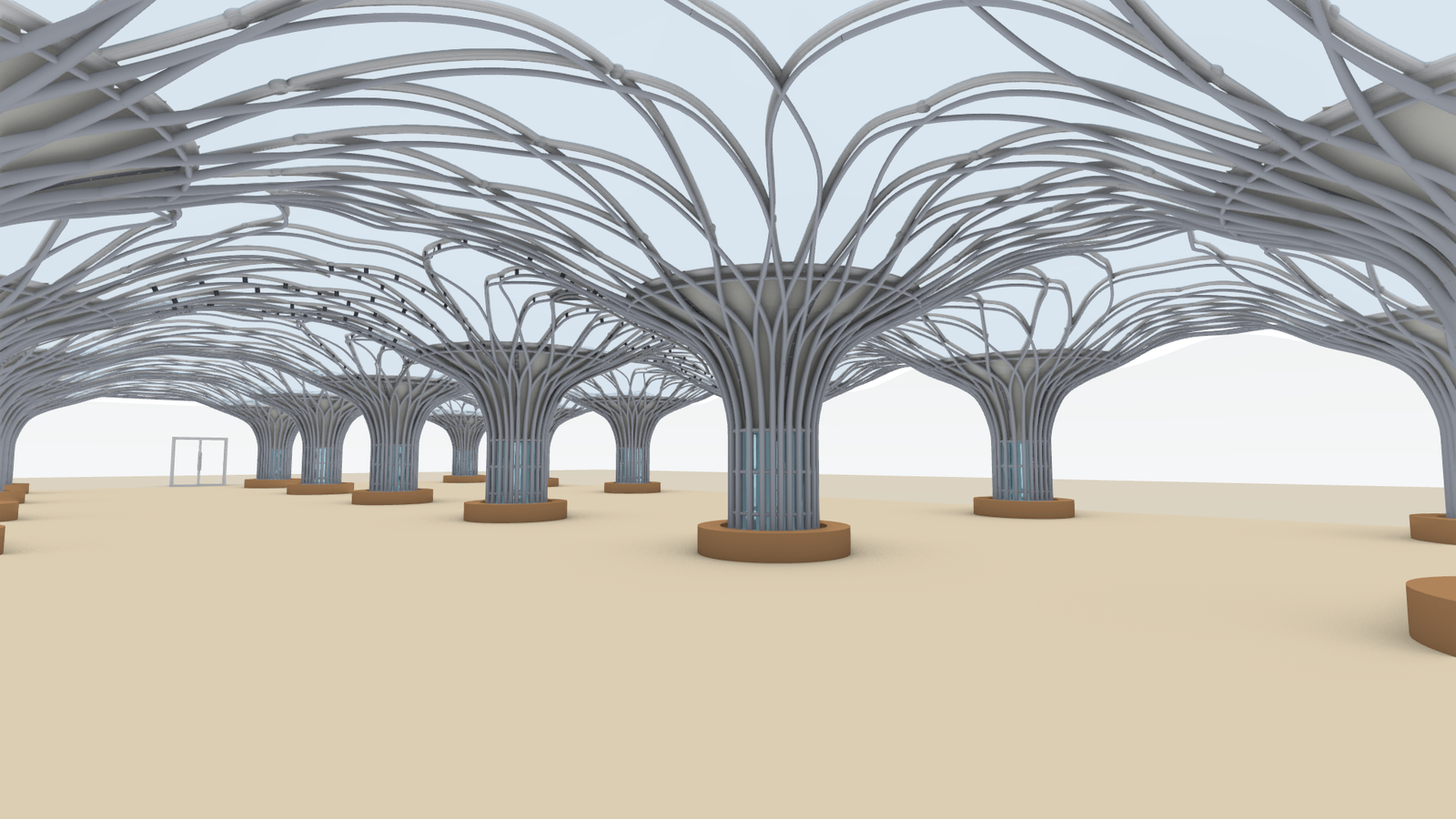
- From the ModelCamera, trees, ribs and funnels, glass downpipes, planter rings and the glazed line on the right. Nano Banana redrew the ribs from the model view rather than copying them, so rib positions in the render are close to the model but not exact.
- Added by Nano BananaETFE cushion finish and rain specks, steel finish, light, gravel floor, people, planting, the restaurants and the buildings beyond. The buildings beyond come from the image model, not from the project.
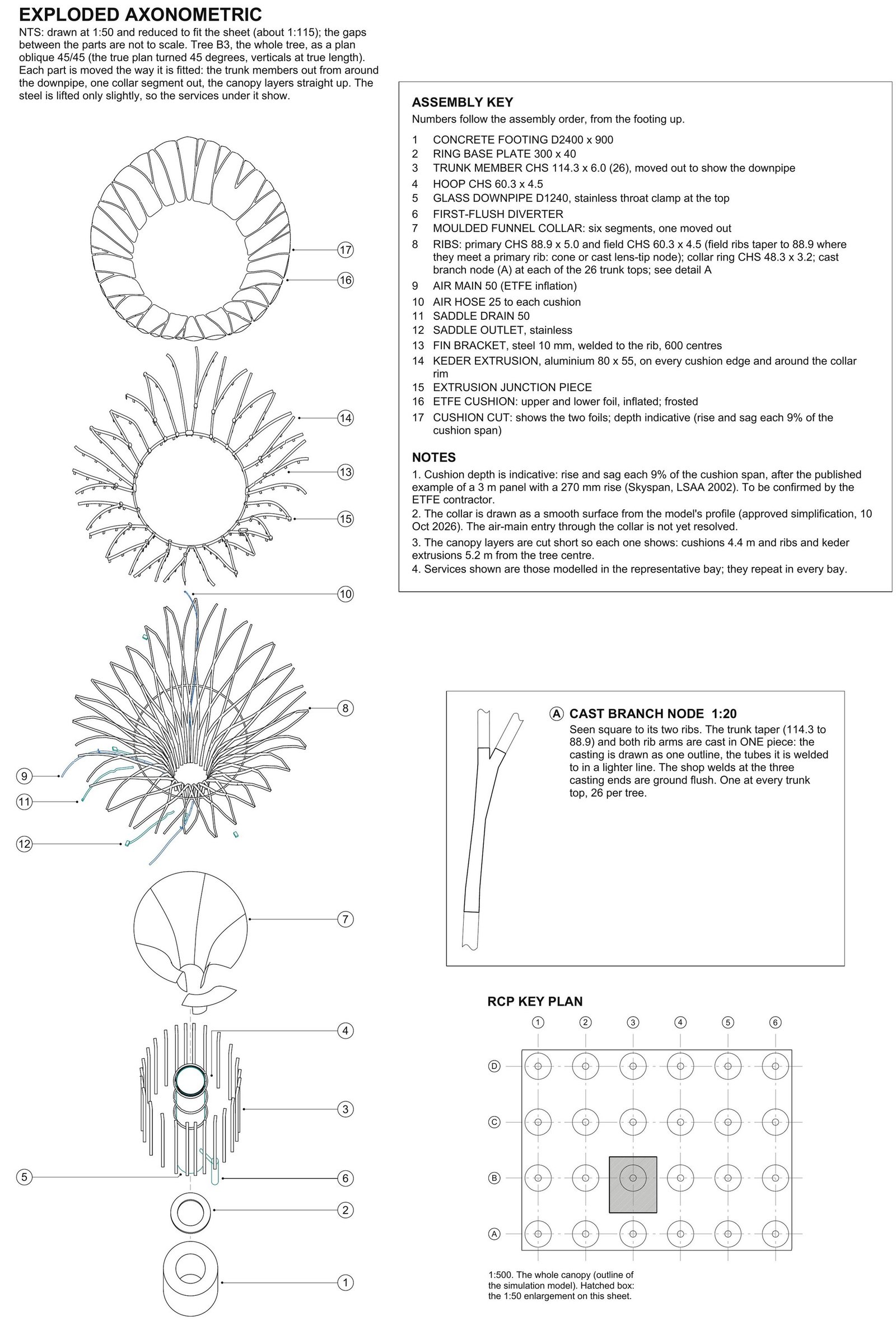
- Omitted, Approved 10 Oct 2026Representative-bay fixings and services (fin brackets, bolts, saddle drains, air hoses and main), because they are modelled in one bay only.
- Hand Edits to the ImageNone. The issued file is pass 4 resized to 1920 × 1080.
- Hand Edits to the Line DrawingsNone. The RCP drawings on sheet A4-01 were drawn by script from the Rhino model and issued as drawn.
The Four Passes
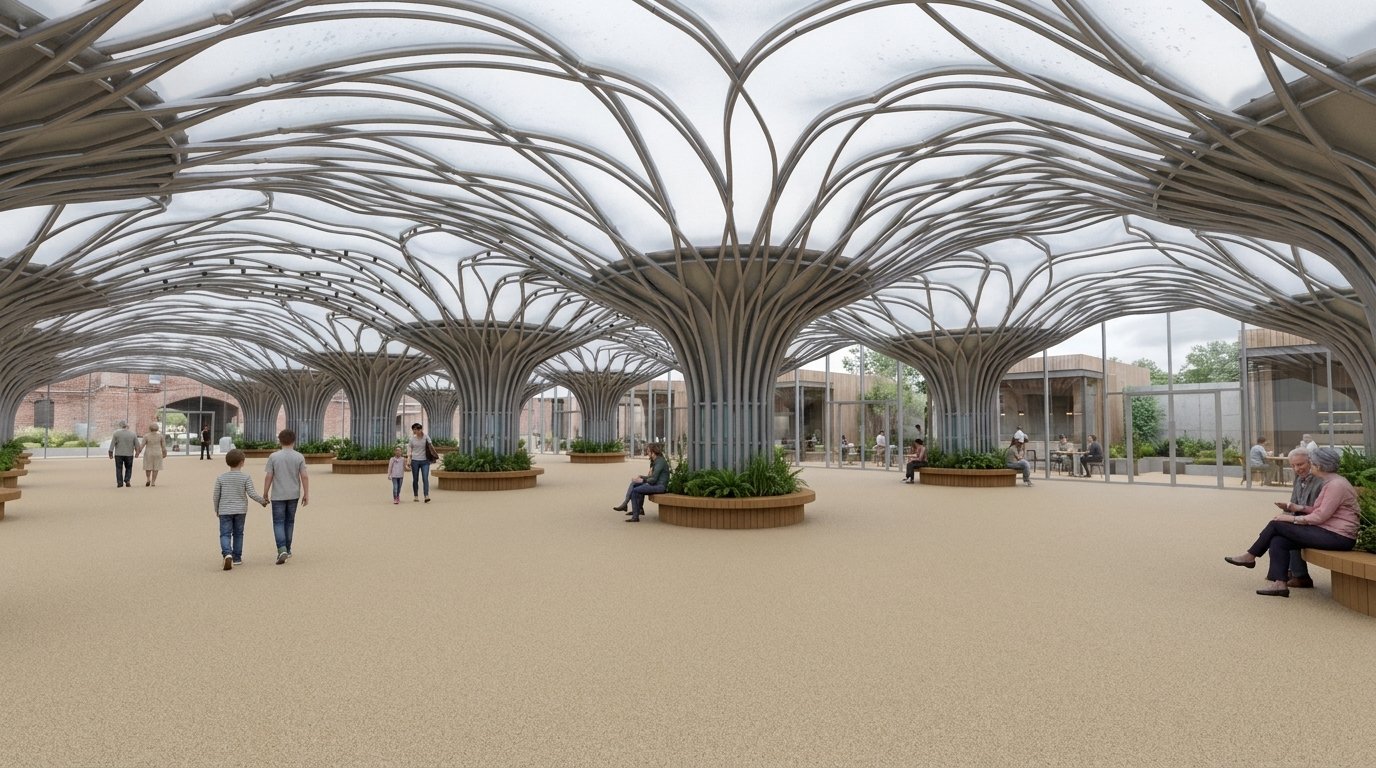
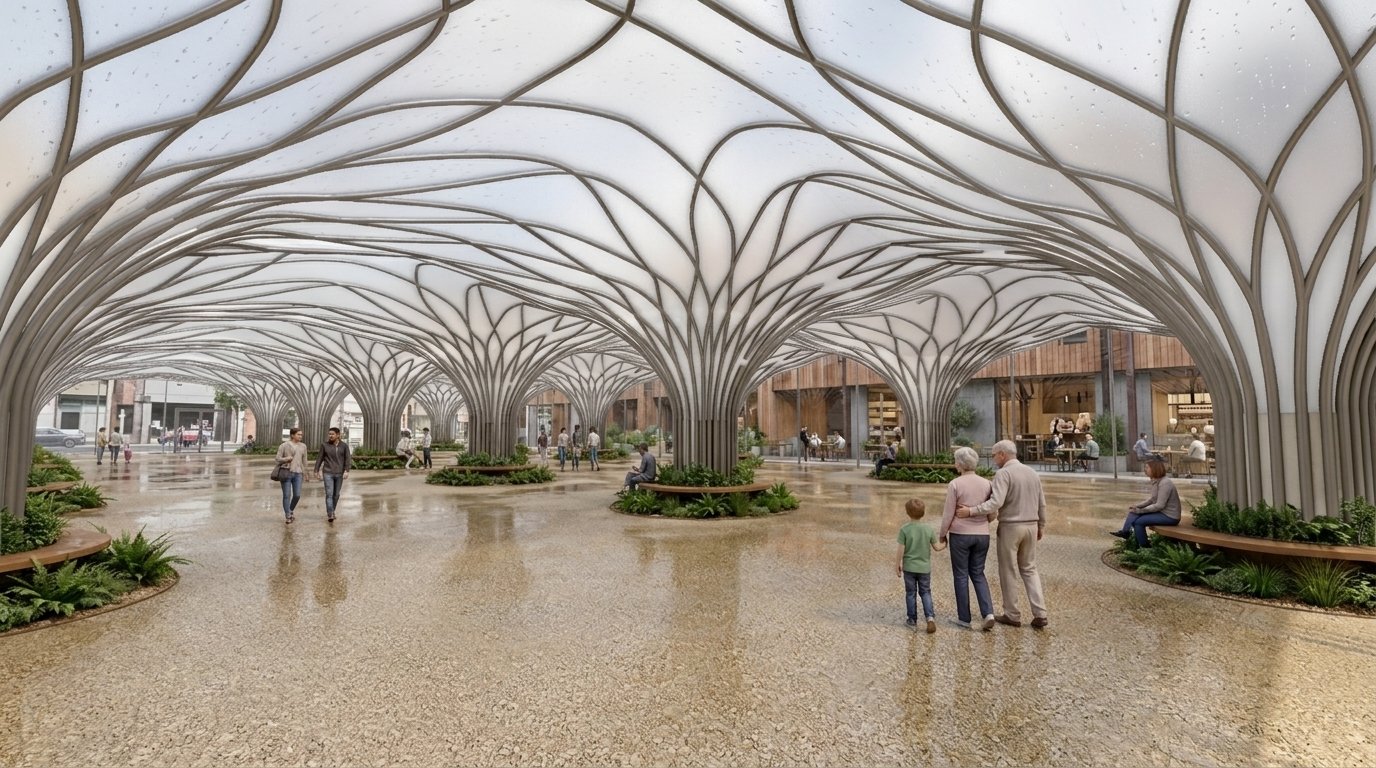
Recorded in rounds 198 to 201 of the canopy exchange log. Cause recorded for passes 2 and 3: the earlier render was given as a reference image.

Tested, not assumed
Three questions decided the canopy: does the steel frame work, does the skin drain, and should the skin be glass or ETFE. The text below is set from sheet A4-02 word for word.
1 Structure: Karamba3D frame check
PROVISIONAL design-development check: loads and limits assumed (AS/NZS 1170), to be verified by a structural engineer.
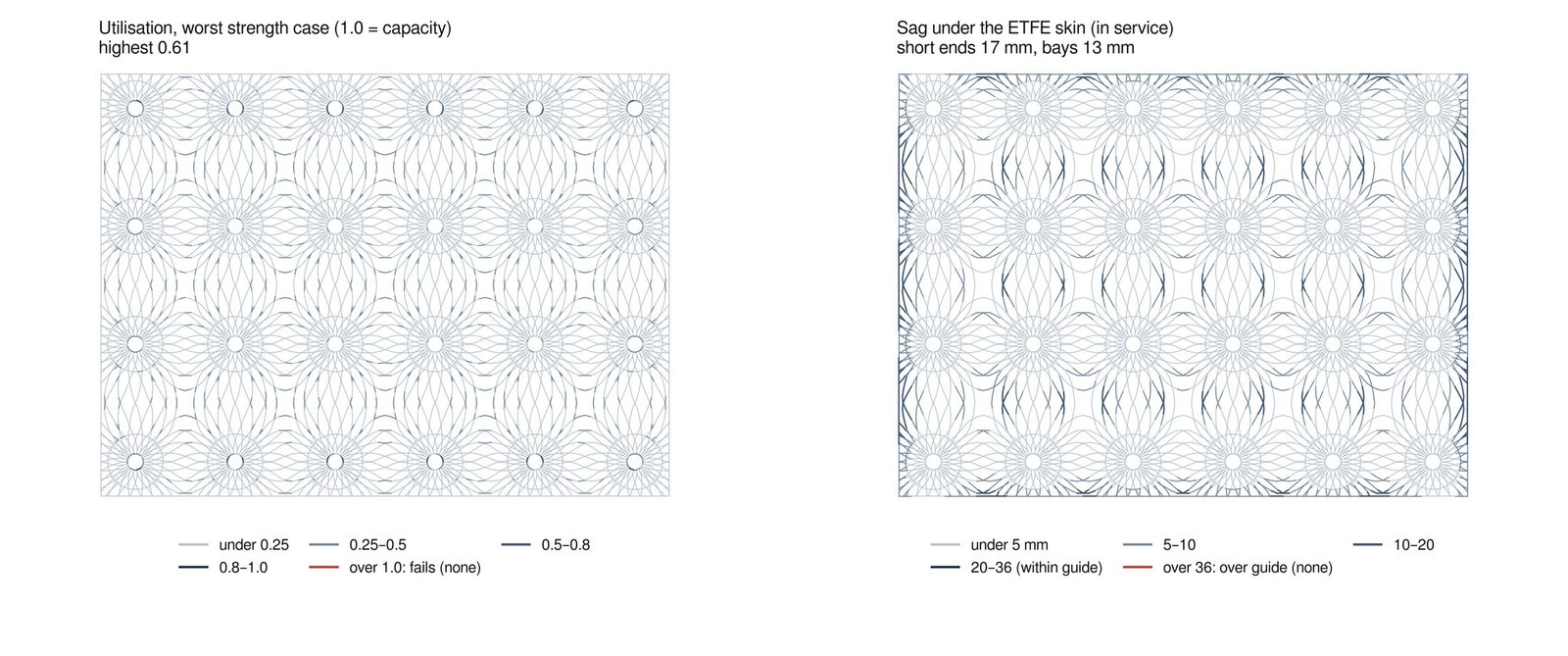
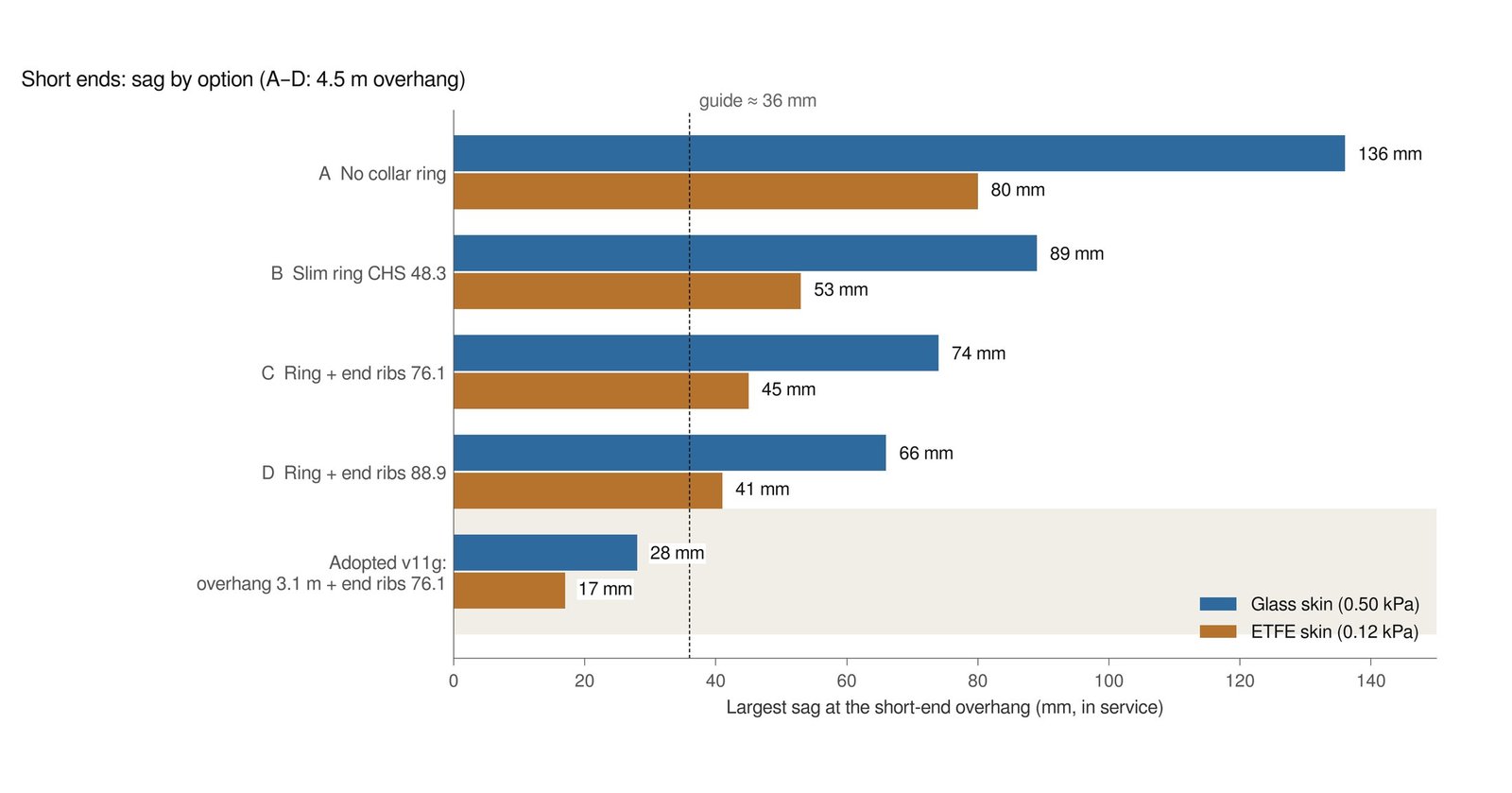
The full steel frame (24 trees, about 19,200 beam elements, S355) in Karamba3D under assumed loads: ETFE 0.12 kPa or glass 0.50 to 0.65 kPa including fixings, roof live load 0.25 kPa, wind uplift 0.50 kPa, temperature ±25 °C. Four options (A to D) for the collar ring and end ribs, then a shorter short-end overhang.
Strength was never the limit: with the slim collar ring every member stays well below capacity. Without the ring the hoops at the throat fail (1.17). Sag governs, and only at the two 4.5 m short-end overhangs: 41 to 136 mm against a guide of about 36 mm.
Slim collar ring CHS 48.3 kept. Short-end overhang cut from 4.5 to 3.1 m (outline 51.2 x 38.0 m) with end ribs CHS 76.1. Adopted frame v11g: highest utilisation 0.61; short-end sag 17 mm under ETFE (28 mm under glass at 0.50 kPa, 33 mm at 0.65 kPa); thermal movement 7 mm, so no movement joint; 84.2 t of steel.
2 Water: does the skin drain?
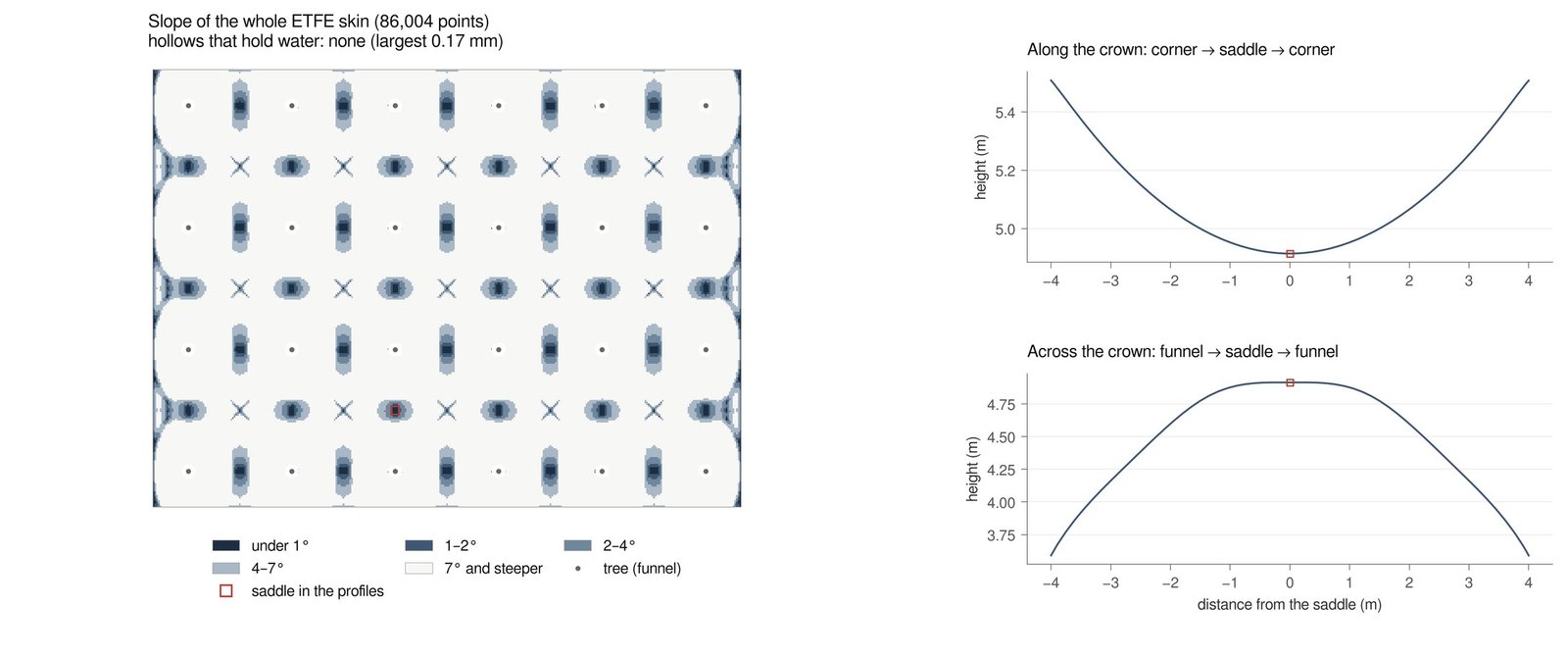
Geometry checks on the model, not a rain simulation. Cushion rise and the weight of water are not included.
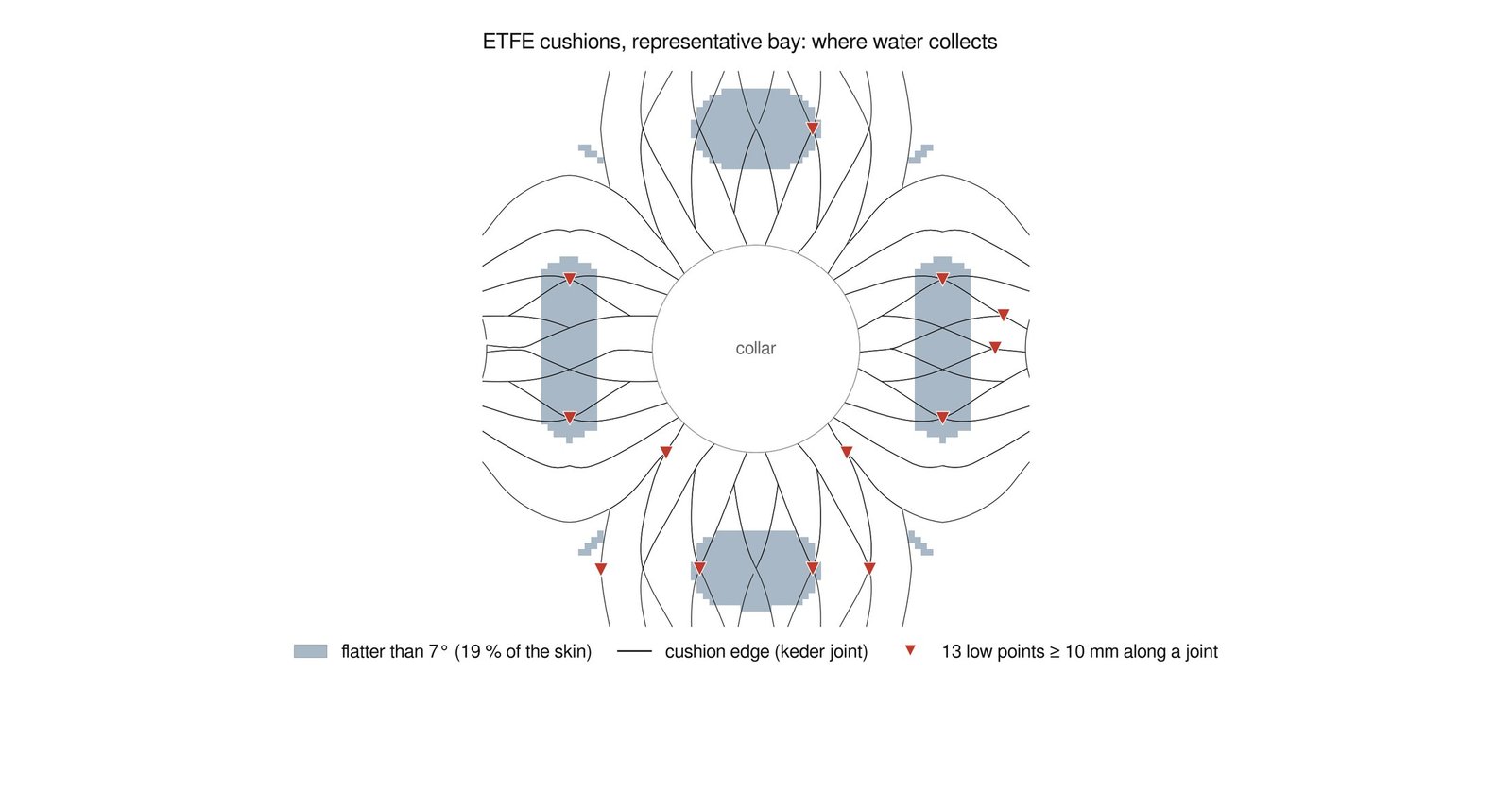
A priority-flood over all 86,004 points of the smooth skin: water may leave only at the edge or into a funnel. Repeated with the Karamba sag of the frame laid over the skin (ETFE, twice ETFE, glass). Then the 43 cushion joints of the representative bay.
No hollow holds water in any case (deepest 0.17 mm; 0.3 mm with the sag, which is grid noise). But the saddles midway between the trees are almost flat (about 0.5° along the crown), so water leaves them slowly, and 13 points along the cushion joints in the bay sit 10 mm or more below their surroundings.
A drained saddle node: a stainless outlet under the keder at each joint low point, with a 50 mm drain along the side of the steel to the nearest collar at a steady fall of at least 1:100. 13 outlets per bay, 211 over the whole roof.
3 Skin: glass or ETFE?
Desk research (R1, R3, R4) and the same water test; not yet confirmed by a glazing or ETFE contractor.
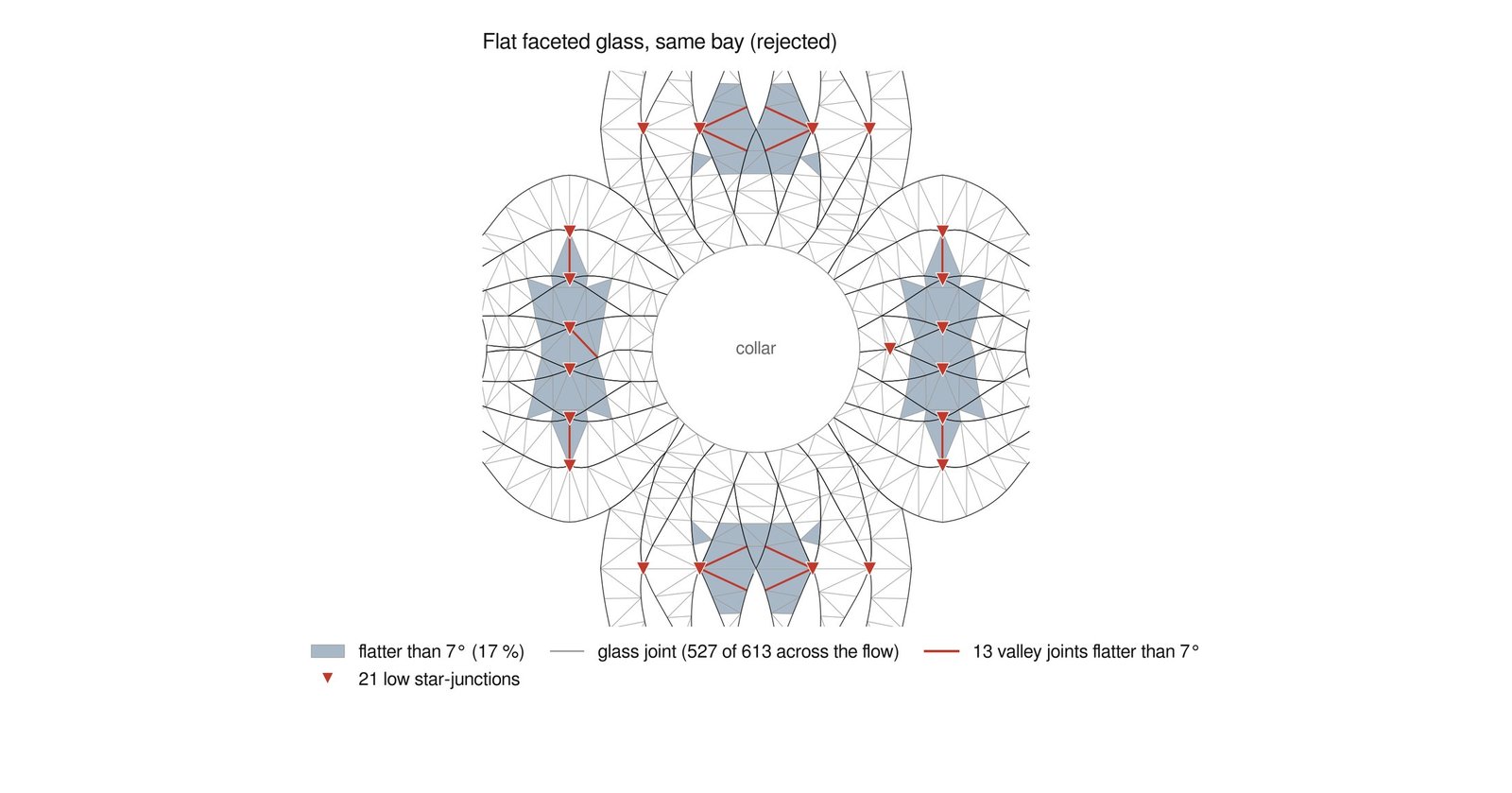
Laminated frosted glass against fritted ETFE cushions on weight, the frame check, solar heat gain, fit to the doubly curved form, watertightness, the experience of rain and the quality of the harvested water. The water test was run on a flat-faceted glass version of the same bay.
The frame can carry glass; the problem is water. On this shape 17 % of the glass would be flatter than the 7° glass-roof minimum, 527 of its 613 joints lie across the flow, and 21 star-junctions collect water. Hot-bent glass would need a mould for each of the 580 doubly curved panels.
ETFE cushions selected: frosted and fritted for solar control; rain is heard and seen as soft shadows. Three conditions for the stored water: a first-flush diverter at each downpipe, AS/NZS 4020 compliance or leaching data for every wetted part, and testing the stored water before use. A back-up fan and emergency power are required.
| Laminated glass (frosted, fritted) | ETFE cushions (fritted) | |
|---|---|---|
| Weight (incl. fixings) | 25 to 60 kg/m²; 0.65 kPa in the frame check | 2 to 3.5 kg/m²; 0.12 kPa in the frame check |
| Frame check (adopted v11g) | short-end sag 33 mm (guide 36); highest utilisation 0.70 | short-end sag 17 mm; highest utilisation 0.38 |
| Solar heat gain (SHGC) | about 0.27 (coated, fritted double glazing) | about 0.35 to 0.48 (fritted 2 to 3 layer cushions) |
| Doubly curved form | flat facets or cold-bent panels; hot-bent needs one mould per panel (580) | follows the curvature cushion by cushion |
| Watertightness (bay test) | 17 % below the 7° minimum; 527 joints across the flow; 21 low star-junctions: not shown to be feasible | sealed cushions in a capped keder frame; 13 low points along joints at the saddles: drained outlets |
| Rain experience | rain seen; quiet | rain heard; seen as soft shadows through the frit |
| Harvested water | not assessed (R3 covered ETFE) | fluoropolymer (PFAS family); runoff risk unquantified: three conditions |
| Upkeep | very durable; cleaning | 30 to 50+ years; cleaning every 2 to 3 years; fans serviced; back-up power |
| Outcome | REJECTED (flat faceted and hot-bent) | SELECTED |
Under the canopy in the rain
Rework, Counted
Counted from the canopy exchange log, 6 to 11 Oct 2026, with the same definition as the site reading: a correction round is one recorded instance of my rejecting or correcting an output, followed by a revised output. Choices between options and approvals are not counted.
| Workstream | Correction rounds |
|---|---|
| Strategy and brief, before modelling | 10 |
| Form tests | 3 |
| Model and structure | 10 |
| Skin fixings | 3 |
| Renders and animation | 4 |
| Drawings and sheets | 20 |
| Reports and scope | 2 |
| Total | 52 of 286 rounds, 6 to 11 Oct 2026 |
- 15 further rounds are borderline and not counted; with them the total is 67.
- 8 outputs were rejected outright, and 14 routes were stopped or abandoned.
- The repeat gate was created at round 156, after I had caught the rib gaps by eye twice (rounds 86 and 146). It was then used on 6 repeatable elements and caught 2 more faults before they were repeated.
Documentation
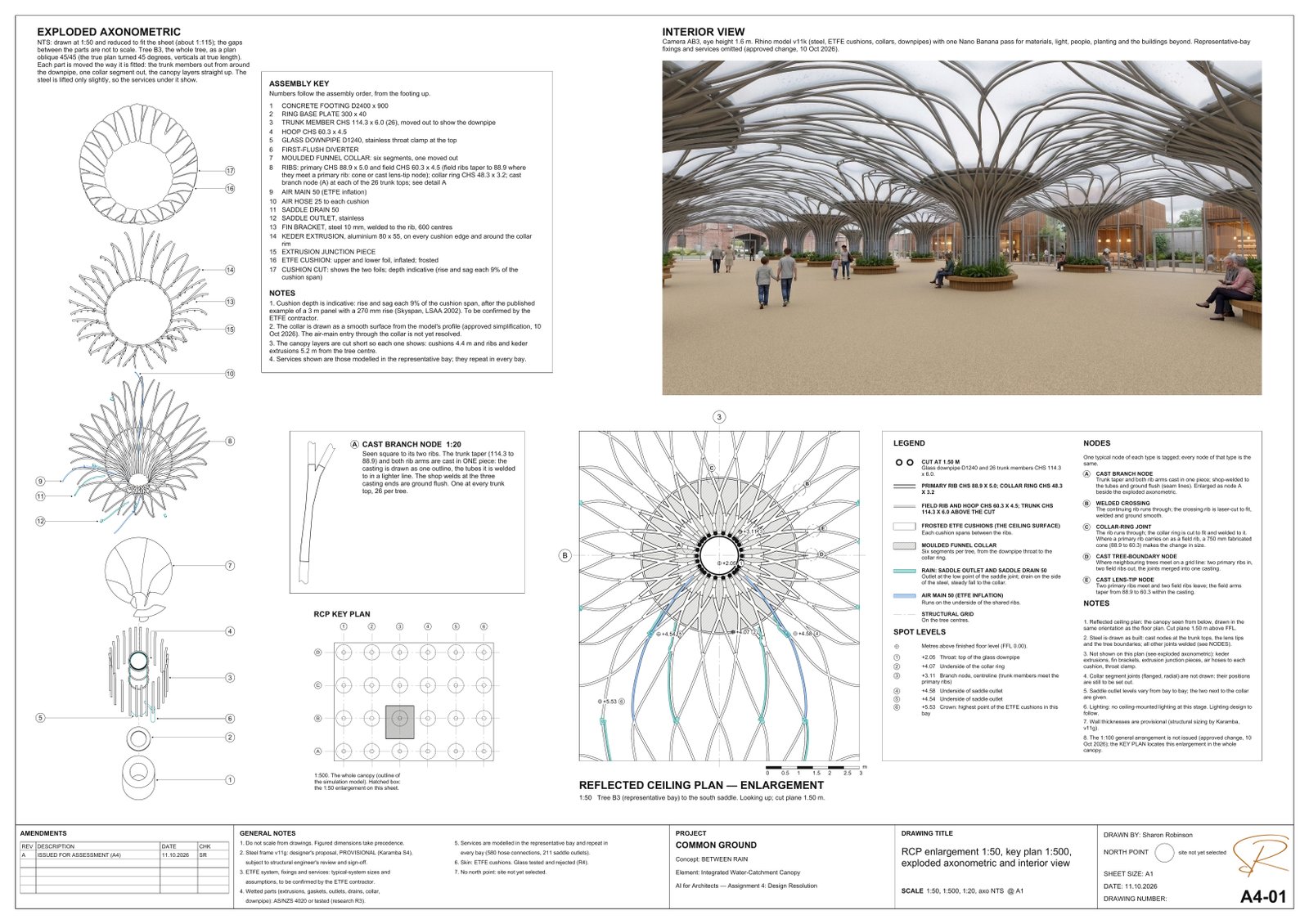
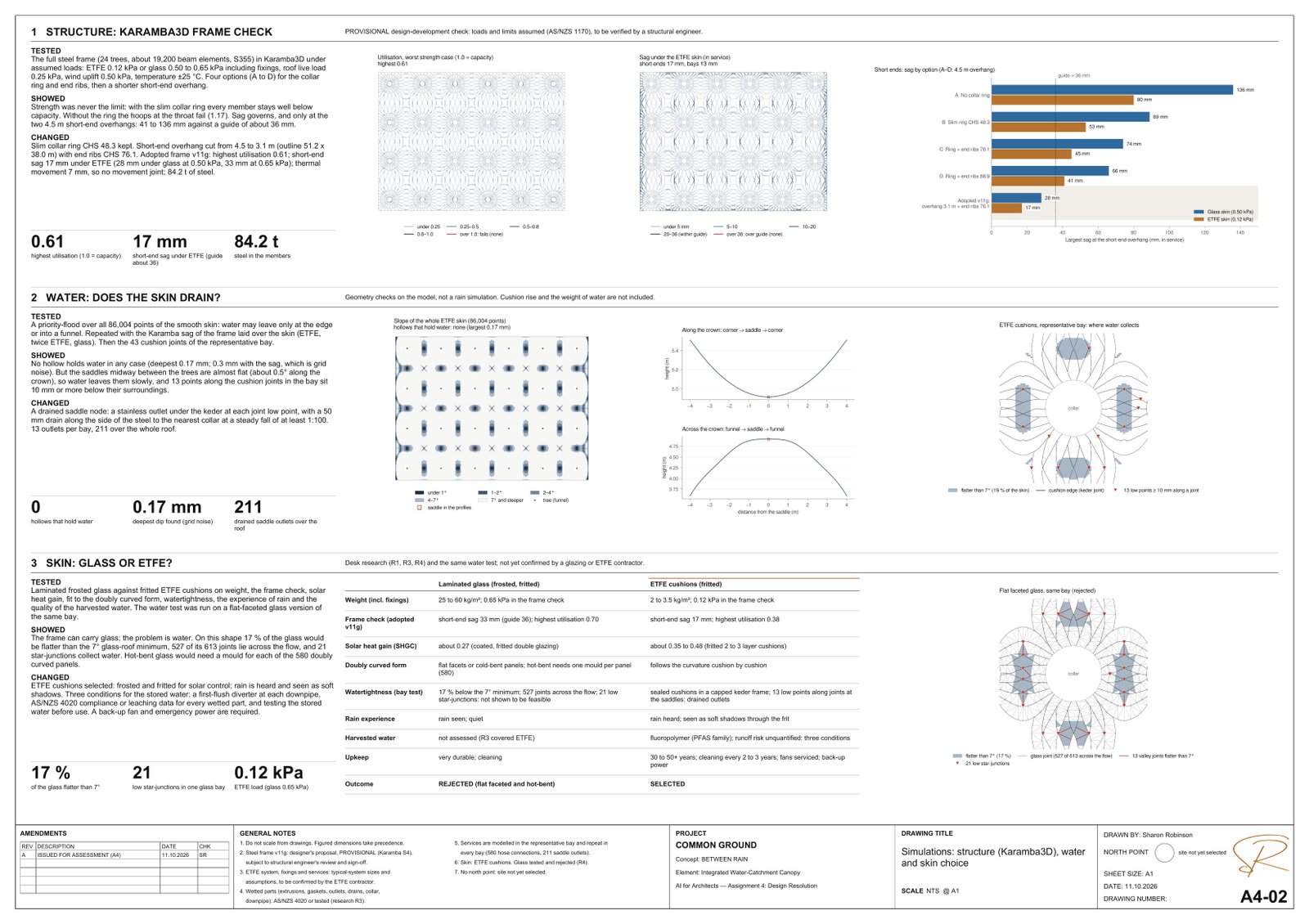
Sheets: A4-01 RCP enlargement, key plan, exploded axonometric and interior view; A4-02 simulations, as issued 11 Oct 2026. Reports: 01 Structure (Karamba3D), 02 Water, 03 Skin (glass or ETFE).
Still to Do
- Exploded axonometric (G-09): linework incomplete; to be redrawn and updated.
- Spot level 6 (F-03, F-07): label and value wrong on A4-01. Correct in the next revision.
- ETFE cushion foils (F-02): missing from the model (only the cushion edge surface is modelled). Add, indicative rise and sag 9% of span.
- Trunk members (F-01): unevenly spaced and touching in places. Verify on one tree, then correct the set-out.
- Structure (G-10): designer’s proposal, provisional; needs a structural engineer.
- Open canopy (G-11): resolved; the canopy is open at its edges, see The Proposal. Damping the rain sound on the ETFE is still open.
- Section through the funnel and canopy (G-13): resolved: the 1:50 section on The Proposal cuts through the gate tree’s collar, glass downpipe and chamber.