AI for Architects · Working method
Approach
AI did much of the production on this project: research, scripting, drawings, images and this website. The design decisions stayed with me. These are the rules, skills and records that keep that division clear, with the evidence of how much rework each output needed.
01 · Rules
The Rules Every Tool Works Under
- Authorship. AI proposes; the designer decides.
- No Fact Without a Source. Every site fact is checked against its primary source.
- No Silent Omission. Nothing is cropped or left out without asking first. Added after a diagram cropped part of the site unannounced.
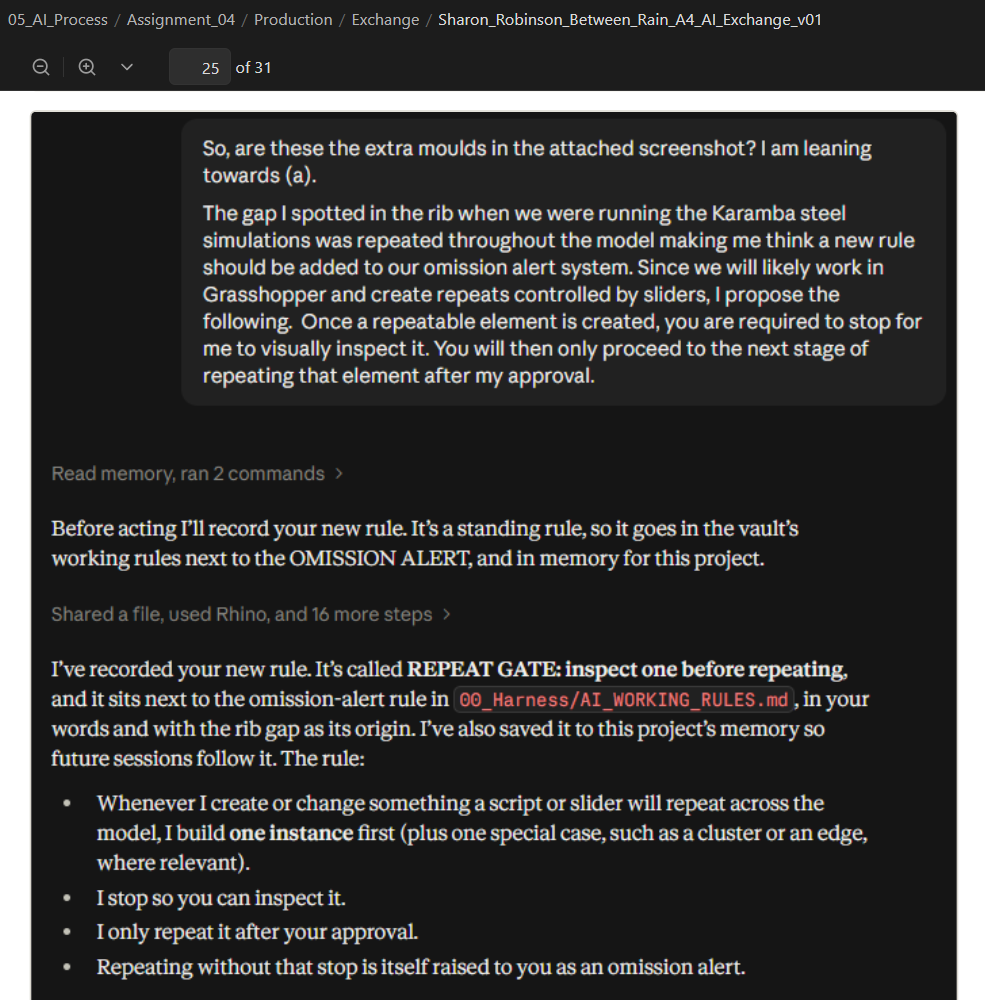
- Repeat Gate. One instance is built and inspected, and nothing is repeated until the designer approves it. Added after one broken rib was repeated at nine places, and later used on the cast branch node, where a fault was caught in the single instance before the node was repeated 234 times.
- A Second System as Critic. ChatGPT reviews outside the production chain.
The Rules Explained
Authorship
AI proposes, researches and computes; the designer makes the final decisions. AI suggestions may be accepted, modified or rejected, and the rejections are recorded.
No fact without a source
Every site fact on a drawing has an entry in a verification register. Facts retrieved by AI stay unconfirmed until checked against the primary source, and an empty dataset is recorded, never read as “no constraint”.
No silent omission or transformation1 Oct 2026
Before anything is cropped, left out, simplified or changed, the tool stops and raises an Omission Alert: what changes, why, what it does to the reading, and a recommendation. Nothing proceeds without the designer’s approval, and an approved change is stated on the output.
Added after the frame of Diagram 01 cropped part of the site and the crop was never raised.
Repeat gate9 Oct 2026
Anything that will be repeated across the model is built once and inspected, and it is repeated only after the designer approves it. A later change to it goes through the gate again.
Added after a broken rib, made by one rule, was repeated at nine places across the canopy. Later used on the cast branch node, where a fault was caught in the single instance before the node was repeated 234 times.
A second system as critic
ChatGPT sits outside the production chain as a critic, so a check comes from a different system from the one that produced the work. Its notes come back as instructions.
The full working rules are kept in the project record and are available on request.
02 · Skills
Skills Written for This Project
Each is a set of written instructions that an AI tool loads and follows, so the same method runs the same way again.
Three skills: Concept Critique, Site Reading Harness, and Model and Documentation Review. Full skill texts are available on request.
What Each Skill Does
Concept
Concept critique
Tests a concept, diagram or image against the project’s recorded intent. It flags generic, decorative, over-resolved or unevidenced work and questions sustainability claims. It never decides the design.
Full skill text available on request.
Ground
Site reading harness
The sequence of evidence passes, the context each tool is given, eleven guardrails and the prompts, written once so the site reading can be run again on another lot.
Full skill text available on request.
Review
Model and documentation review
Drafts a review register for a model and its drawings, checks every finding against a named source and recommends with reasons, then stops. Only the designer accepts, closes or defers a finding.
Full skill text available on request.
03 · Review
The Review Register in Use
Model and Documentation Review Register
A Claude skill drafted seven findings from real project records and stopped at each one. Every decision is mine, and I overruled three of its proposed severities.
About This Register
Model and Documentation Review Register
The integrated water-catchment canopy, reviewed by a Claude skill that fills the register from my project records and then stops. Every finding waits for my decision, and the skill never closes one.
In the record below, A4 is the canopy stage and A5 is the review stage. Jet is my course tutor.
Both inputs are real project records, not written for the exerciseProjectCommon Ground · Between RainElementSmart Farm canopy (the canopy model)RegisterRun 05 + decisions, 15 Oct 2026DesignerSharon Robinson
The register: seven findings
1 · The register
Seven findings, each stopped for my decision
The left side of each finding is what the skill drafted, copied unchanged from its run 05 output, except that two record references show my initials (SR) instead of my name. The right side is my seal: the severity I set, my decision and my reason, in my own words. The stop points are S1 accept, S2 approve the fix approach and S3 close on named evidence. The A4 submission stays as issued, and every fix applies to future outputs.
Key
- F-01… findings, the register’s rows. O- observations, noted but no recorded decision breached. NCF items not carried forward, because a later record already settled them.
- IN-01, IN-02 the two inputs. SRC-01…05 the source records each finding is checked against. R178 · L10 round 178, line 10 of my A4 exchange log.
- S1 accept and set severity · S2 approve the fix approach · S3 close on named evidence. These are the three points where the register stops for me.
- Fix approved means I have decided it will be fixed; the fix has not been carried out yet. Deferred means I have decided not to fix it at this stage. No finding is closed, and nothing in the model or drawings has been changed.
Shown here: element, finding, inputs, source breached, proposed severity and recommendation. Inference flags and the reasoning appendix are in the full register file, A5_REVIEW_REGISTER.md.
Trunk members unevenly spaced, touching in places
Drafted by the skill
- Element
- Members leaving the trunk, around the collar; every tree
- Finding
- Members unevenly spaced; touch each other in places. R04: C5 and C4 show visibly uneven gaps in the centre tree’s flare in sheets model v31, so it persists in the current version; in C5 several members appear in contact
- Seen in
- IN-01 R178 SR ¶1 (L10); Claude “Noted for A5” (L23); R288 (L177); IN-02 C5, C4 (centre tree)
- Breaches
- Designer’s logged item, IN-01 L10: “something to note for A5 and beyond”; SRC-01 L204–205 open “uneven verticals on the public face”, “fix public-face spacing” (no later decision in SRC-05)
- Severity, proposed
- Medium: buildability (SRC-03 L151: close tubes hard to weld, paint, clean) and radial order of every tree
- Recommendation
- Verify then fix. Measure clear gaps between all trunk members and primary ribs in one tree; fix even angular set-out in the tree-module rule. Repeated across 24 modules (two mirrored): inspect one tree first (REPEAT GATE). Does not resolve: rib pattern beyond the collar; Karamba re-run after.
Designer’s seal
Severity Medium proposed Medium kept
Accept. What did I mean? The trunk members around the centre tree are unevenly spaced, and some members appear to touch or bunch together. I want this verified on one tree first rather than assuming the whole set-out is wrong. If confirmed, fix the set-out and use that corrected logic for the other trees.
Reason This can be deferred until the final project unless it affects something I need to show for A5.
Sharon Robinson, designer · 15 Oct 2026
ETFE cushion foils missing from the model
Drafted by the skill
- Element
- ETFE cushions, whole roof (580; Rhino model v11k, GH v11j)
- Finding
- Model holds only the cushion edge surface; indicative foils exist as data only
- Seen in
- IN-01 R195 research (L75–78); R196 decision (L120); R288 (L177)
- Breaches
- Designer’s logged item, IN-01 L120: “TO DO in A5 and beyond: add the upper and lower foils (rise = sag = 9 % of span, indicative) to the model” (also SRC-05 L7303); SRC-02 L107
- Severity, proposed
- Medium: model under-states skin height and depth; F-03 depends on it
- Recommendation
- Fix. Build foils on the 580 S5a panel outlines (SRC-02 L21–26) at 9 % of each short span, labelled indicative. Repeated: one median cushion + one collar-edge cushion at the REPEAT GATE first. Does not resolve: 9 % rests on one precedent (IN-01 L75); contractor to confirm.
Designer’s seal
Severity Medium proposed Medium kept
Accept. The cushion foils are missing from the model, so I agree this is something that ultimately needs to be fixed. I don’t think modelling all 580 panels at 9% is necessary just for A5 if the defect and intended correction can be demonstrated on the two test cushions. Defer the full canopy correction to the final project.
Reason I don’t want A5 to turn into another modelling exercise when the assignment is about identifying defects and making decisions. (Two-cushion test also deferred; reconsider if my tutor indicates that demonstrating a correction would add value.)
Sharon Robinson, designer · 15 Oct 2026
Spot level 6 names the wrong surface
Drafted by the skill
- Element
- RCP 1:50, spot level 6, legend; sheet A4-01 (v32; sheets model v31)
- Finding
- Legend reads “+5.53 crown: highest point of the ETFE cushions in this bay”; +5.53 is the cushion edge level
- Seen in
- IN-01 R195 OMISSION ALERT (L102); R196 (L111, L119); R288 (L177)
- Breaches
- Designer’s logged item, IN-01 L119: “TO DO in A5: correct it (the value is the cushion edge level, not the top of the upper foil)”
- Severity, proposed
- Medium: a level on an issued drawing misdescribes what it measures
- Recommendation
- Fix, after F-02. Relabel 6 as cushion edge level and add the top of upper foil (indicative) from the model. Issue as a new revision; submitted sheets stay as issued (SRC-05 L8703). Does not resolve: foil height stays indicative; the value itself (F-07).
Designer’s seal
Severity Medium proposed Medium kept
Accept. The Spot Level 6 label is wrong and should be corrected in the next appropriate revision.
Reason The Spot Level 6 label is wrong.
Sharon Robinson, designer · 15 Oct 2026
Exploded axo (A4-01): missing linework in the drawing
Drafted by the skill
- Element
- Exploded axonometric, sheet A4-01 (geometry v06b)
- Finding
- Open tube ends; ribs without closing lines; keder and fin ends; steps in tube and fitting outlines
- Seen in
- IN-01 R206 SR (L134), screenshots (L136), diagnosis (L139–142); R288 “axo linework” (L177)
- Breaches
- SRC-05 R207 L7492 (latest record; IN-01 R206 left it pending): “The linework defects are accepted as a limitation at this stage (to be stated in the report; A5 to-do)”
- Severity, proposed
- Low: drawing only; model unaffected (IN-01 L141)
- Recommendation
- Fix. The two causes named at IN-01 L139–140: smooth drawn width along each tube; end caps as small ellipses drawn last. Renderer change hits every tube: test on one group (core) first, compare with v06b. Does not resolve: any gap from another cause.
Designer’s seal
Severity Low agrees with proposed Low
Accept as Low severity. Fix the two renderer causes and test the correction on one group. I don’t think the whole model needs to be reworked for A5 if the test demonstrates that the cause and correction are understood. We can defer the full correction to the final project.
Reason I don’t want A5 to turn into another modelling exercise when the assignment is about identifying defects and making decisions. (One-group test also deferred; reconsider if my tutor indicates that demonstrating a correction would add value.)
Sharon Robinson, designer · 15 Oct 2026
Axo linework limitation never stated on the sheet or in the report
Drafted by the skill
- Element
- Reports PDF v02 and A4-01 axo notes
- Finding
- No record in SRC-05 that the accepted linework limitation was stated in the report or on the sheet
- Seen in
- IN-01 R206 Claude recommendation (L142)
- Breaches
- SRC-05 L7492 “(to be stated in the report; A5 to-do)”; SRC-04 L119: “Any approved omission, partial representation or transformation that affects the reading is stated on the sheet or in the output”
- Severity, proposed
- Medium if absent: non-negotiable rule; missing lines could read as design
- Recommendation
- Verify then close. Designer checks Reports v02 and A4-01 v32 for the statement (evidence: page and line). If absent, state it on the A5 outputs; submitted files stay as issued. Does not resolve: F-04.
Designer’s seal
Severity Low overrules proposed Medium
I accept D-05 as Low severity. The linework limitation was identified but wasn’t included in the submitted A4 documentation. I agree this is a documentation defect. The submitted files will remain unchanged, but we need to state the limitation wherever the axonometric is used in the future.
Reason The linework limitation was identified but wasn’t included in the submitted A4 documentation.
Sharon Robinson, designer · 15 Oct 2026
Rain animation limit not stated
Drafted by the skill
- Element
- Rain animation v05 (v05b same picture); website landing page
- Finding
- Approved captions cover sound only; no record that the visual limit (drops move in straight lines in the image, pass under ribs) was stated
- Seen in
- IN-01 R247 Claude “Limit (to state if shown)” (L166)
- Breaches
- IN-01 L166; SRC-04 L72: “identify uncertainty and limitations rather than presenting speculation as fact”
- Severity, proposed
- Low: the website note says movement is “generated by script” (SRC-05 L8573)
- Recommendation
- Verify then close. Designer checks the caption text in the frozen snapshot. If absent, add it wherever the loop is reused in A5; the submitted site is not republished. Does not resolve: a real flow path needs a surface-flow simulation.
Designer’s seal
Severity Medium overrules proposed Low
I accept D-06 as Medium severity. Although the website explains that the rain animation was scripted, it doesn’t make clear that the shadows are illustrative rather than a simulation of water movement. This distinction needs to be made clear in future presentations.
Reason I think this could be misleading, particularly where the caption suggests the shadows follow the water towards the funnels.
Sharon Robinson, designer · 15 Oct 2026
Spot level 6 value is 45 mm below the skin’s high point
Drafted by the skill
- Element
- RCP 1:50, spot level 6, the value; sheet A4-01 v32 (sheets model v31)
- Finding
- +5.53 is 40 to 50 mm below the recorded top of the skin: crowns 5.57 m and skin up to z 5.58 m. Separate from F-03, which concerns what the label describes
- Seen in
- IN-01 R195 OMISSION ALERT (L102): “+5.53 Crown: highest point of the ETFE cushions in this bay”; IN-02 manifest L5: v31 “z -1.40 to 5.58 m”
- Breaches
- SRC-03 L185, approved change Canopy_Lift +300: “crowns 5.57 m” (no later change in SRC-05; restated at SRC-05 L6416: “5.57 m at the corners”); SRC-05 L7417: skin “z 4.21–5.58 m”
- Severity, proposed
- Low: 40–50 mm on an indicative level; matters because F-03 relabels the same spot
- Recommendation
- Verify then fix. Read the highest skin point inside the RCP bay in v31 (evidence: its coordinates) and compare with +5.53. If different, correct the value in the same revision as F-03. One query; nothing repeated. Does not resolve: top of upper foil (F-02).
Designer’s seal
Severity Medium overrules proposed Low
I accept F-07 as Medium severity. The Rhino measurements confirm that the highest point of the ETFE skin is 5.575m, so the +5.53 label is incorrect. I want both issues corrected together in a future revision, once the cushion geometry is finalised. The A4 submission should remain unchanged.
Reason Even though the difference is only 45mm and this is still a design-stage drawing, I think the severity should be consistent with F-03.
Sharon Robinson, designer · 15 Oct 2026
Inputs and where each finding came from
2 · Inputs and where each finding came from
Two inputs, traced to every finding
Design-review notes
A verbatim extract of seven rounds (178, 195, 196, 206, 244, 247, 288) of my A4 exchange log: the review between me and Claude on 10 and 11 October where I logged items for A5. Nothing inside the rounds is edited.
The skill found that two more rounds with A5 items (207, 246) were missing from the extract, by searching the full log. That was Claude’s selection error when building the input.
Model captures
Five shaded views of the sheets model the A4 drawings came from (v31, a 3 × 3 window of the 24-tree canopy), captured by Claude through the Rhino connector as a standard review set, not chosen to show any finding.
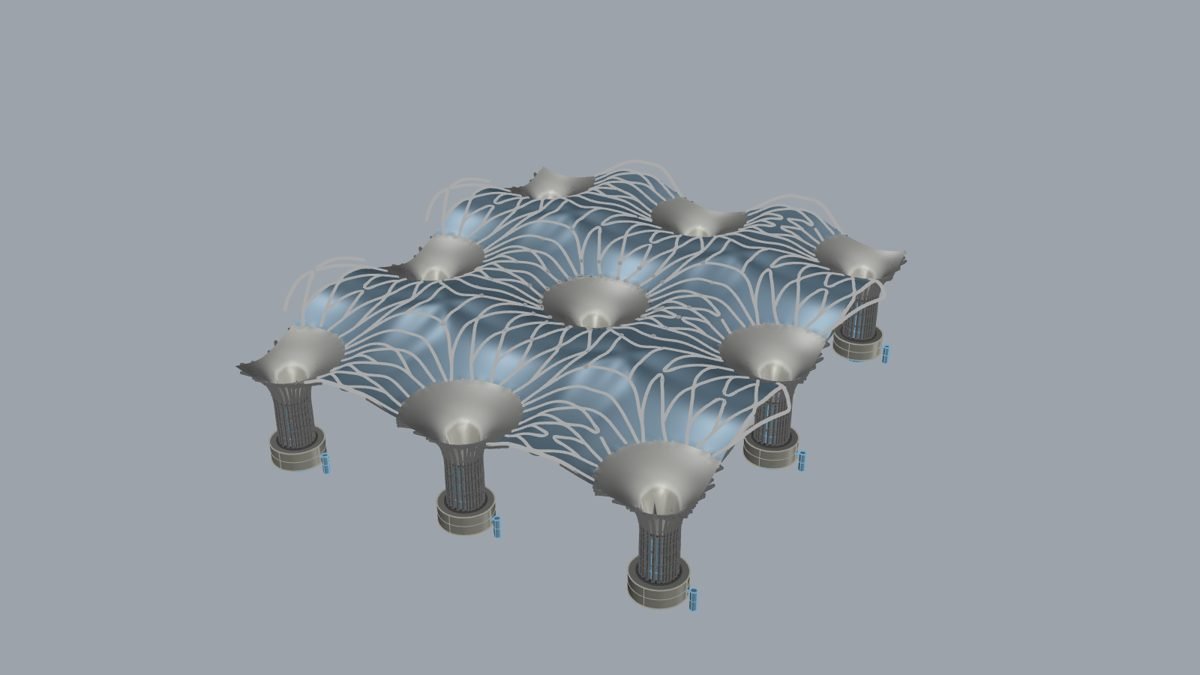
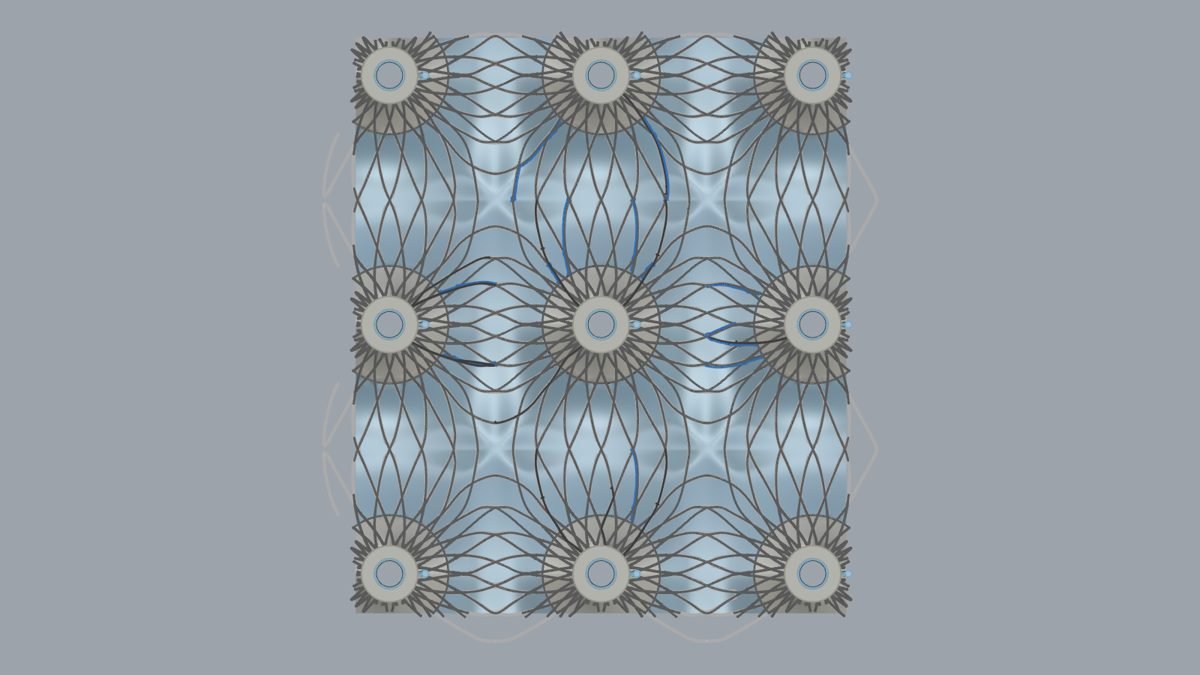
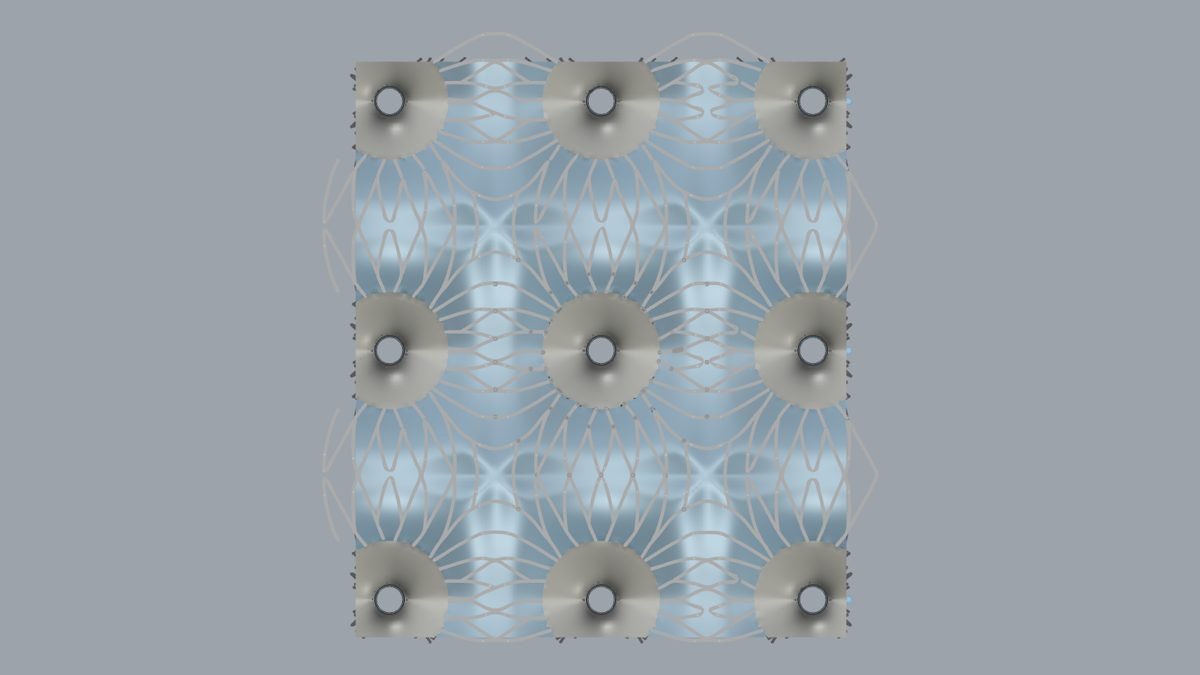
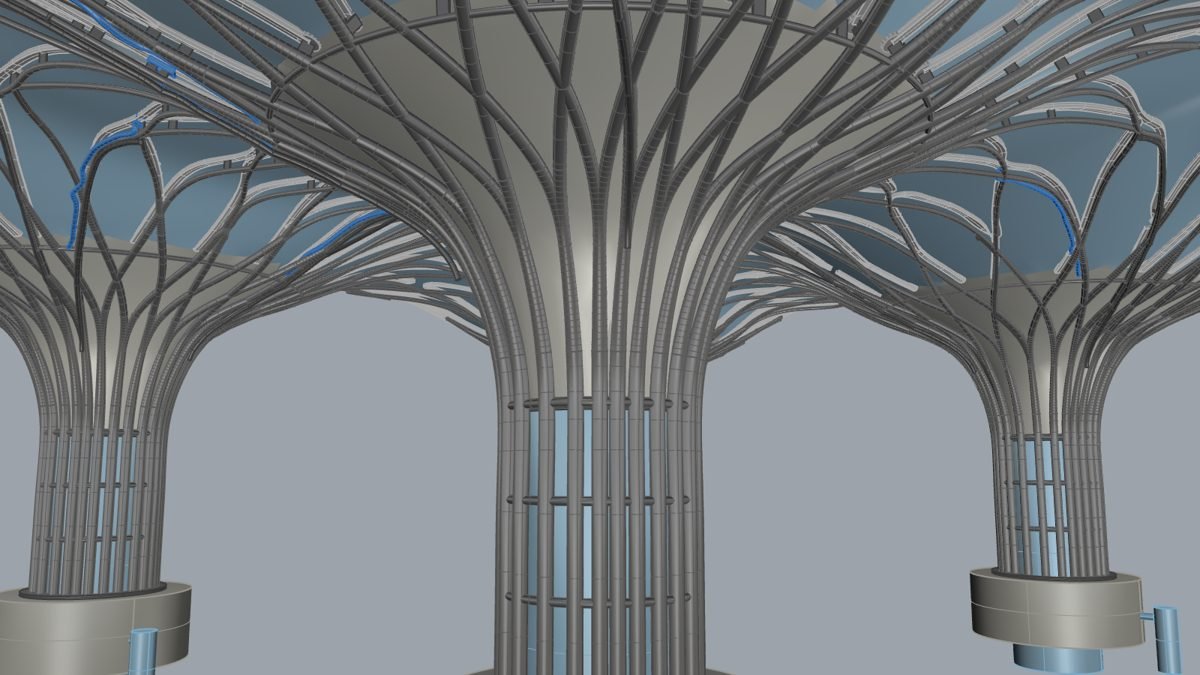
| ID | Item | IN-01 notes | IN-02 captures | My decision |
|---|---|---|---|---|
| F-01 | Trunk members uneven, touching | C4, C5 | Deferred | |
| F-02 | Cushion foils missing from the model | cannot show | Deferred | |
| F-03 | Spot level 6 label | Fix approved | ||
| F-04 | Exploded axo linework | Deferred | ||
| F-05 | Axo linework limitation not stated | Fix approved | ||
| F-06 | Rain animation limit not stated | Fix approved | ||
| F-07 | Spot level 6 value 45 mm low | manifest | Fix approved, with F-03 | |
| O-04 | Short-end rib/skin clash (Round 177, outside both inputs) | outside window | Kept as an open item for the final project | |
| O-07 | Air main ends at the branch-node ring | C4, C5 | Not a finding: recorded as known model incompleteness | |
| O-08 | Members past the skin edge | C1–C3 | Not a finding: cut edge of the 3 × 3 window | |
| NCF 1–9 | Items settled later in A4 (nodes, joins, connectors, axo drafts) | Confirmed as superseded, each with its later round |
The chain that fills it
3 · The chain that fills it
A skill that runs cold, and five runs to get it right
The skill does three things: it drafts each finding, checks it against a named source (no source, no flag) and recommends with reasons. Each run starts in a new chat, so nothing from planning leaks in.
Review notes and Rhino captures, plus five sources: the A4 state, the steel and skin registers, my working rules and the full A4 log.
model-documentation-review drafts, checks and recommends, then writes the raw register and stops.
A second Claude chat reads the register against the inputs and logs what broke.
Accept, set severity, approve a fix or defer it, close on named evidence.
My words go into the Designer columns, unedited. Nothing else changes.
What broke
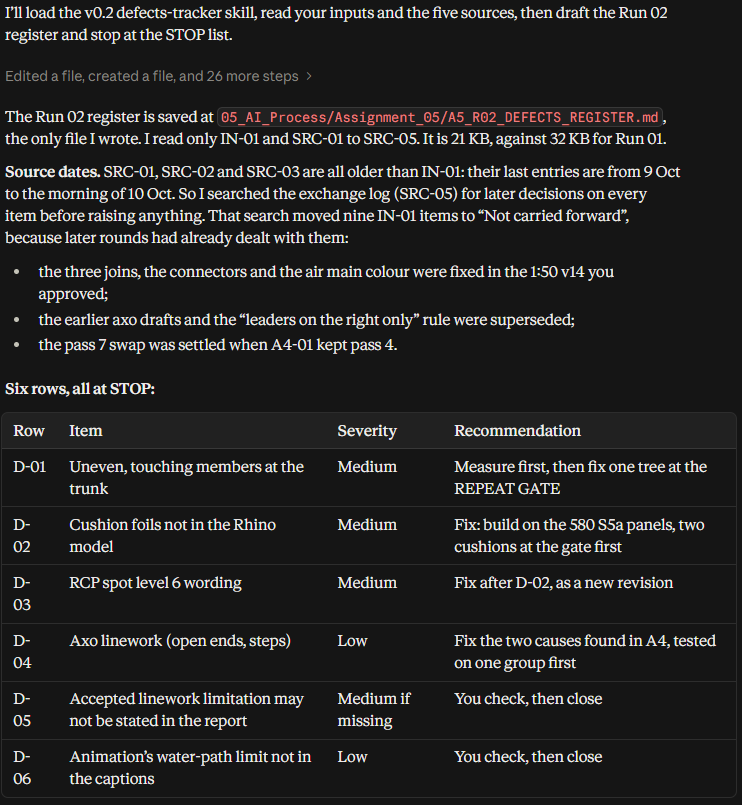
11 rows, with false positives. The sources were dated before the input, and it raised problems on test sheets that had already been replaced. It also left out an item I had logged, and it was too long to check.
What changed
Skill v0.2: a source currency gate, a “subject under review” rule, my logged items count as a source, and about 100 words per row. The full A4 log was added as a source.
Result
6 rows. The false positives moved to “not carried forward”, each with the round that settled it. It also found two A5 rounds missing from the extract.
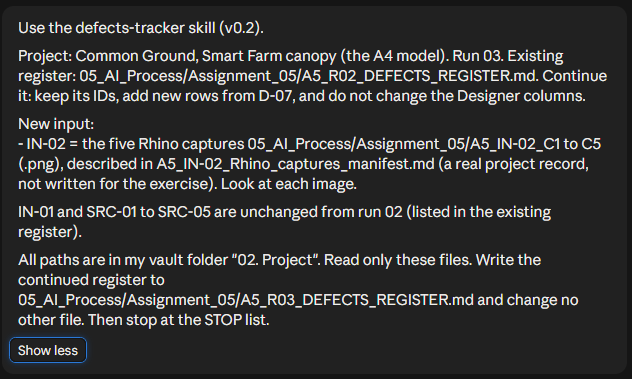
What changed
Nothing. The model captures were taken for the second input.
What broke
No new rows, because the sources were not read again. Claude’s prompt called them “unchanged” and said “read only these files”. The skill should also have stopped and asked for its sources.
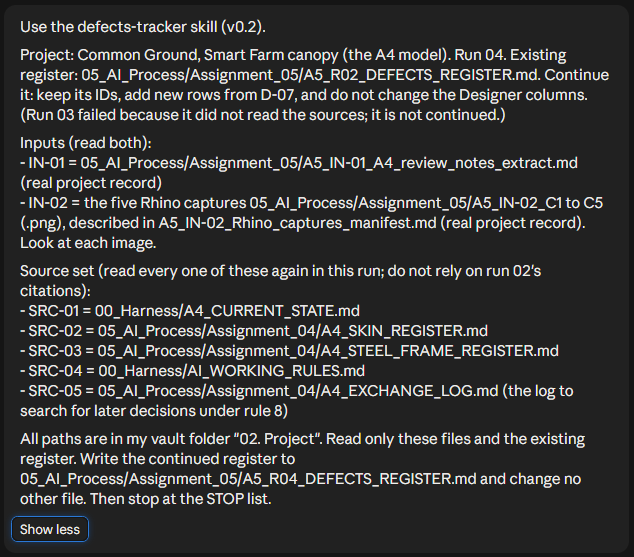
What changed
The prompt now lists every source by path and says to read each one again.
Result
Every citation was checked again. The captures confirm that F-01 is still in the current model. The tube left in mid-air was flagged for me to identify: it is the air main.
Then
My decisions, and two evidence checks I asked for (the A4 report, the sheets and the website). Then a direction check with my tutor.
Result
Skill v0.3, renamed, read from the vault copy because it was not yet installed in my account (it is now). Two more rules: load every source in every run, and keep the designer’s decisions word for word when continuing a register. All my decisions came across unchanged. It raised one new finding, F-07.
Then
A read-only measurement in the model, which I asked for, confirmed F-07. Then my decision on it.
Why runs 01 to 04 were not redone under the new name
Runs 01 to 04 were made while the skill was still called defects-tracker. After my tutor’s advice I renamed the skill and its terms, and tested the renamed skill in run 05. I kept the earlier runs exactly as they happened rather than repeating them under the new name.
The failures in runs 01 and 03 cannot honestly be repeated. Skill v0.3 already contains the fixes those failures led to, so a fresh series would either pass first time and lose the record of what broke, or need failures staged on purpose. I do not stage mistakes in my process evidence. The old name in these runs is the record of the change, not an error to hide.
Run 01 evidence: prompt and raw output
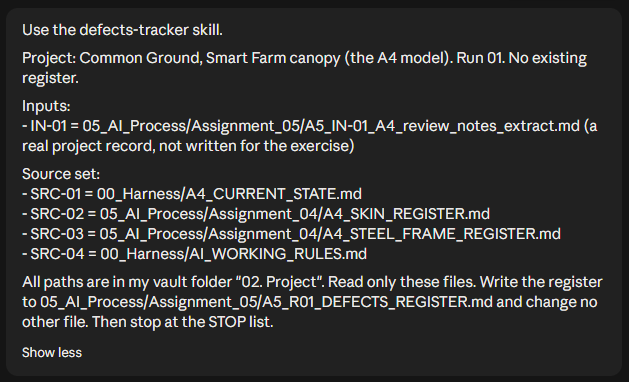
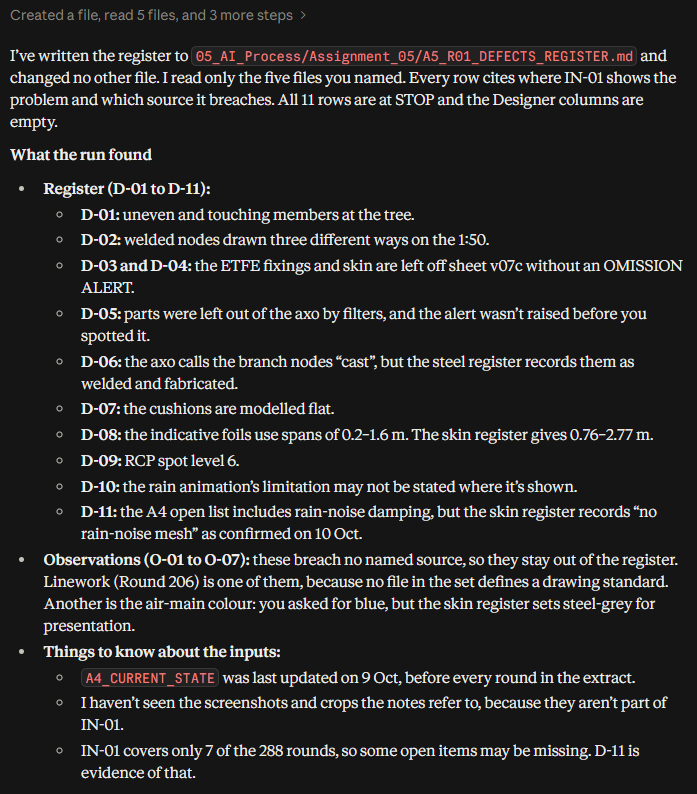
Run 02 evidence: prompt and raw output
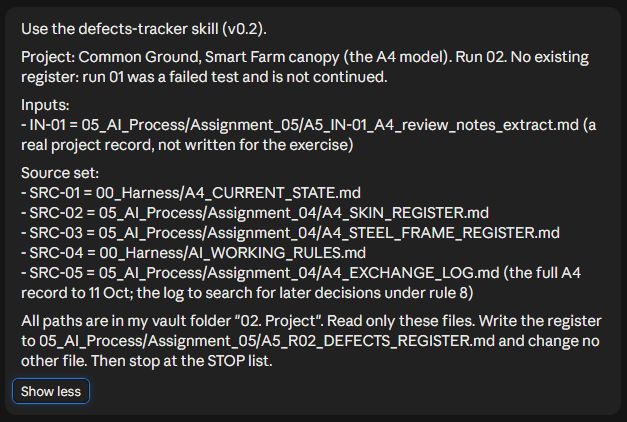
Run 03 evidence: prompt and raw output
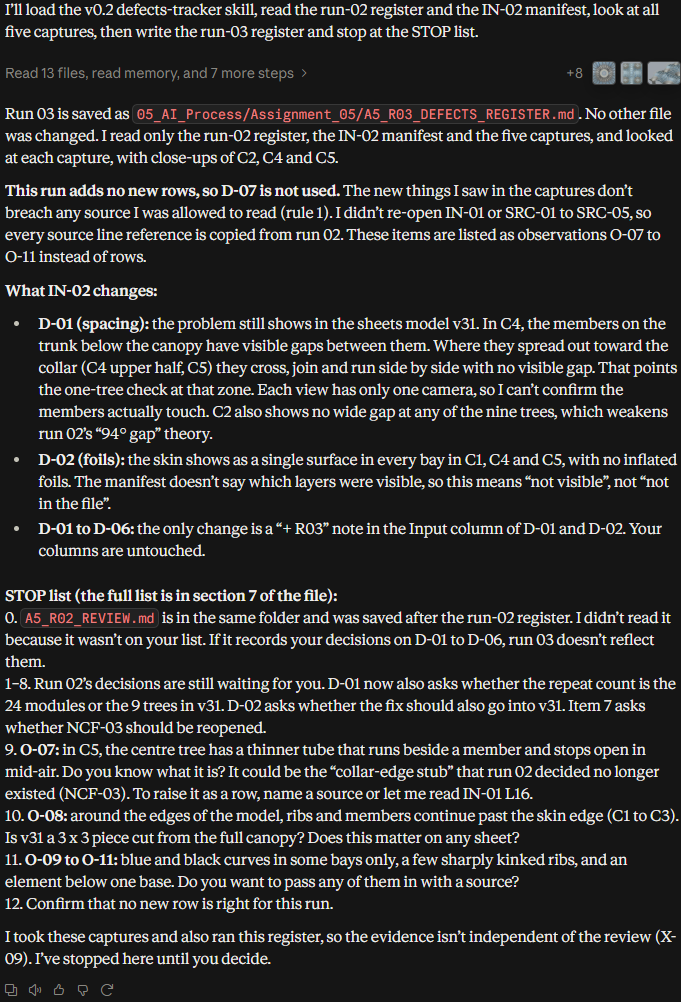
Run 04 evidence: prompt and raw output
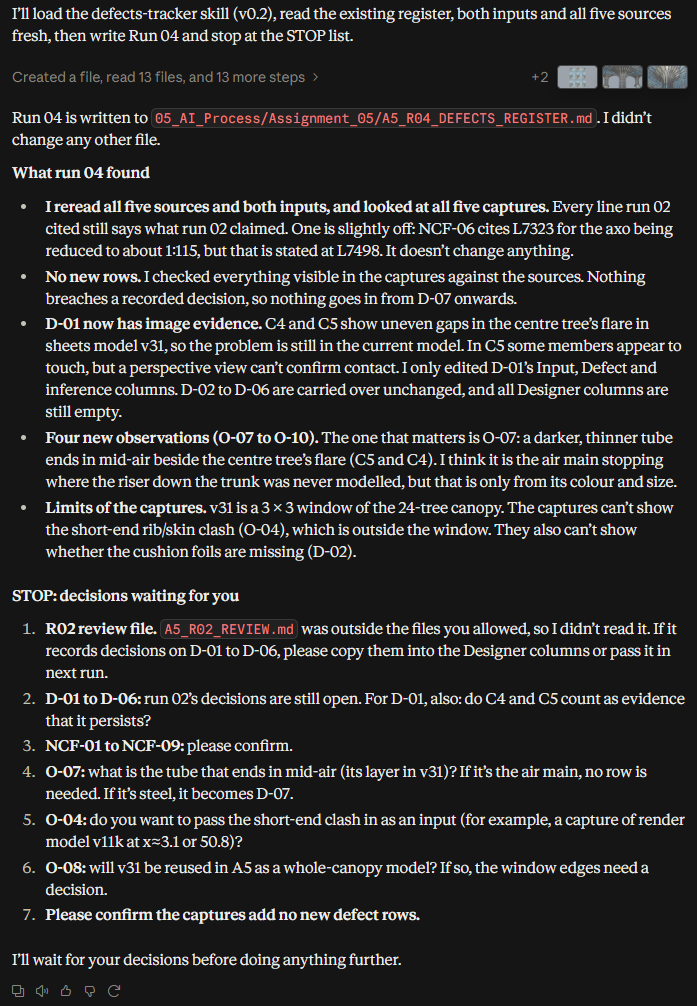
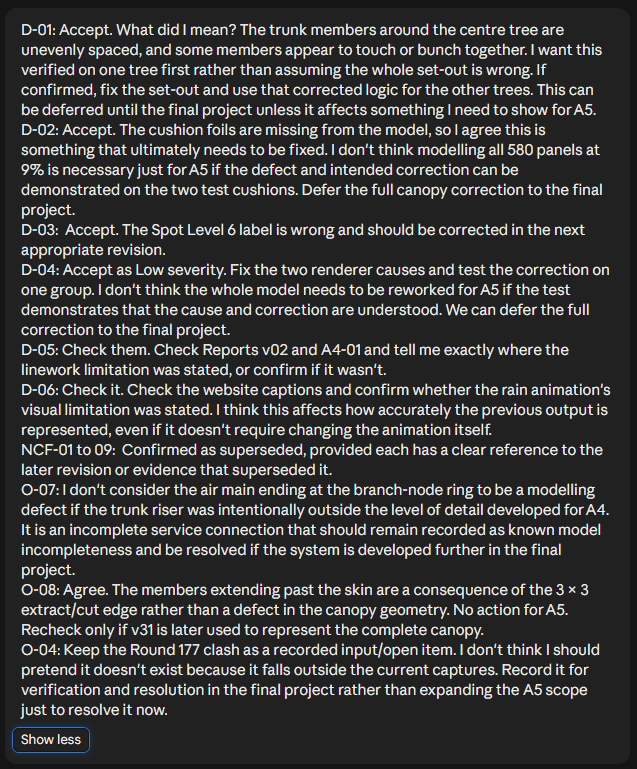
Run 05 evidence: prompt and raw output
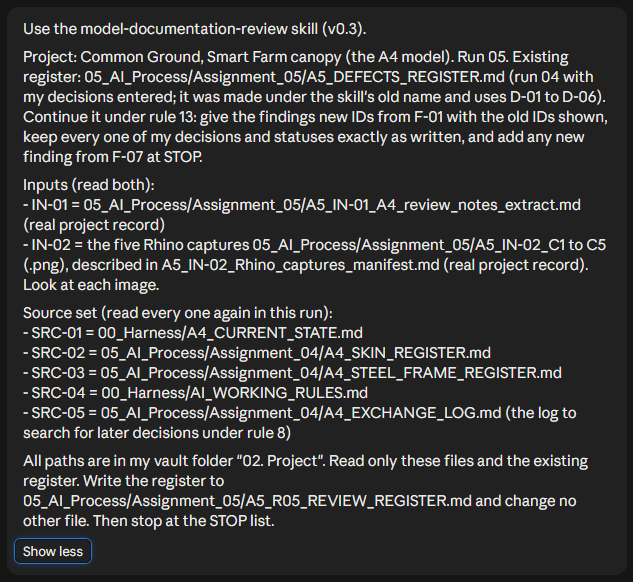
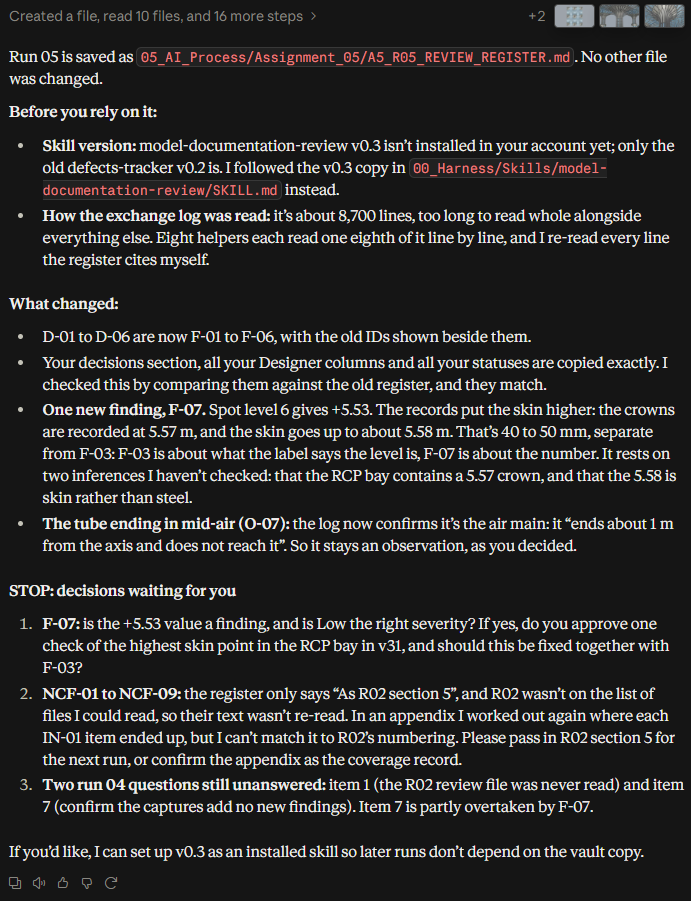
All five prompts, all three skill versions and every raw register are kept in the vault (05_AI_Process/Assignment_05/). Runs 01 and 03 are kept as they failed.
Before and after
4 · Before and after
Raw output, then the register as it lands
Between the raw register and the register as it lands, nothing the skill wrote was edited. What was added is counted below.
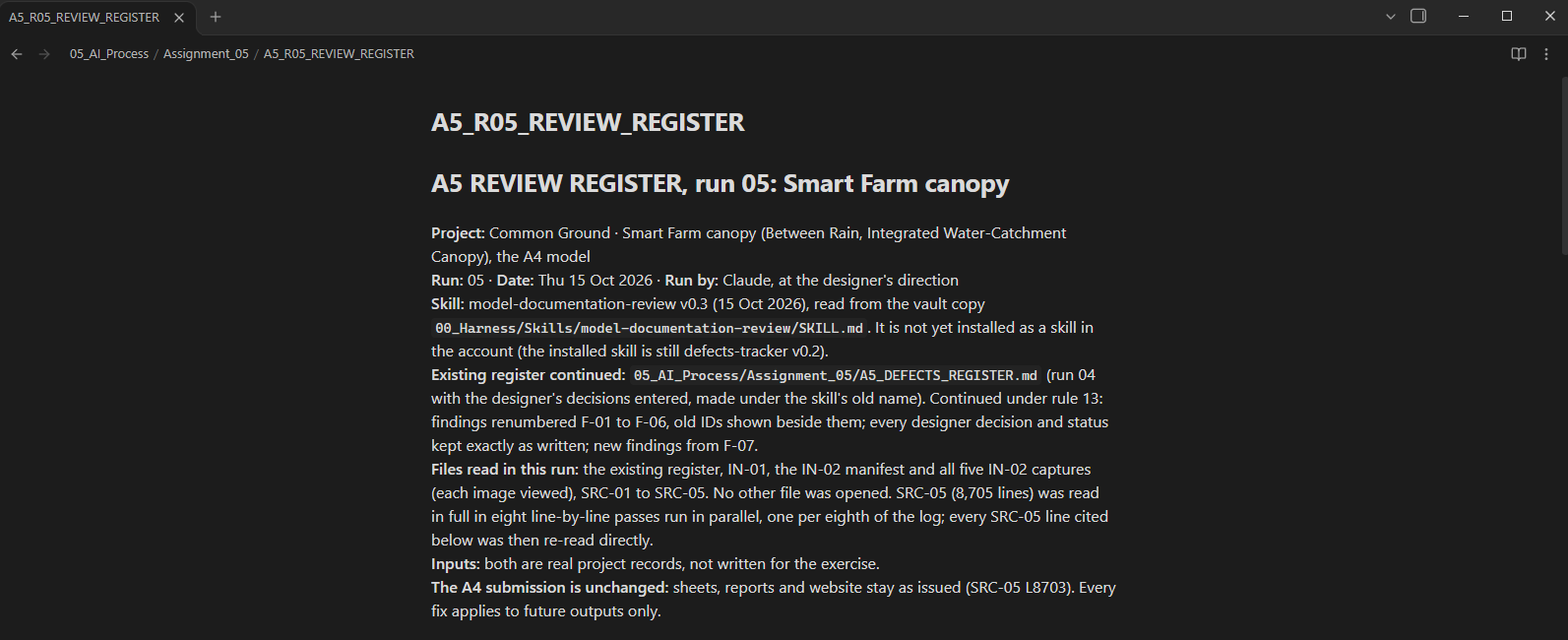
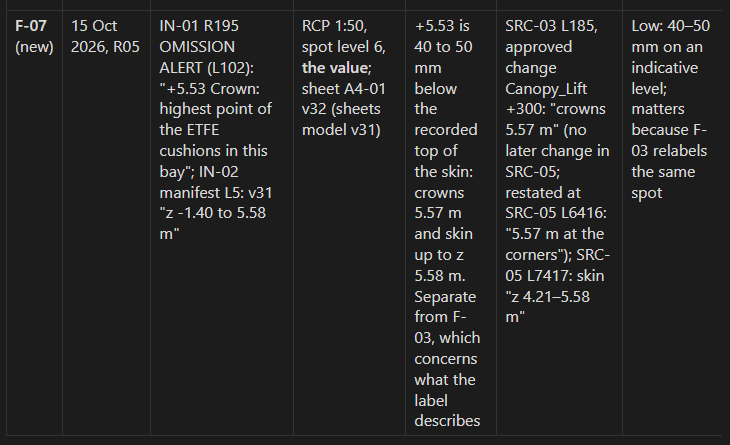
After. F-07 as it lands in the register. The skill’s text is unchanged; my severity, decision, reason and status are added. F-01 to F-06 were decided earlier, on run 04’s stop list, and run 05 carried those decisions over word for word (see The register).
Spot level 6 value is 45 mm below the skin’s high point
Drafted by the skill
- Element
- RCP 1:50, spot level 6, the value; sheet A4-01 v32 (sheets model v31)
- Finding
- +5.53 is 40 to 50 mm below the recorded top of the skin: crowns 5.57 m and skin up to z 5.58 m. Separate from F-03, which concerns what the label describes
- Seen in
- IN-01 R195 OMISSION ALERT (L102): “+5.53 Crown: highest point of the ETFE cushions in this bay”; IN-02 manifest L5: v31 “z -1.40 to 5.58 m”
- Breaches
- SRC-03 L185, approved change Canopy_Lift +300: “crowns 5.57 m” (no later change in SRC-05; restated at SRC-05 L6416: “5.57 m at the corners”); SRC-05 L7417: skin “z 4.21–5.58 m”
- Severity, proposed
- Low: 40–50 mm on an indicative level; matters because F-03 relabels the same spot
- Recommendation
- Verify then fix. Read the highest skin point inside the RCP bay in v31 (evidence: its coordinates) and compare with +5.53. If different, correct the value in the same revision as F-03. One query; nothing repeated. Does not resolve: top of upper foil (F-02).
Designer’s seal
Severity Medium overrules proposed Low
I accept F-07 as Medium severity. The Rhino measurements confirm that the highest point of the ETFE skin is 5.575m, so the +5.53 label is incorrect. I want both issues corrected together in a future revision, once the cushion geometry is finalised. The A4 submission should remain unchanged.
Reason Even though the difference is only 45mm and this is still a design-stage drawing, I think the severity should be consistent with F-03.
Sharon Robinson, designer · 15 Oct 2026
Cleanup count: raw register to register as it lands
- 0 edits to anything the skill wrote.
- 4 cells filled by me on F-07 (status, decision, reason and date). This is my seal, not cleanup. My earlier decisions on F-01 to F-06 were carried over by the skill itself.
- 1 gap filled by hand: the nine Not-carried-forward items, copied verbatim from the run 02 register because run 05 only referred to them.
- 2 notes added: a header saying what changed, and the F-07 evidence (a read-only measurement in the model that I asked for).
How run 05’s stop list was closed
- F-07: accepted at Medium and Fix approved, after a read-only measurement I asked for (see The register).
- NCF-01 to 09: their text was copied in from run 02. My earlier confirmation stands.
- Two questions left from run 04: both already answered. The run 02 review file holds no decisions, and run 05’s own F-07 answers whether the captures add findings.
Who did what
5 · Who did what
The AI types; I decide
| Claude | Drafted the skill and the run prompts at my direction, built the input extract and took the captures. Carried out the five runs in clean chats that I started, reviewed each run, and checked the A4 report, sheets, website and model when I asked. |
| Me | Chose the register and the inputs. Approved the skill changes after each failed run. Took my tutor’s advice to rename the work. Made every decision in the Designer columns and set severity, overruling the proposal on F-05, F-06 and F-07. Kept A5 from becoming a modelling exercise by deferring the fix tests. |
| Where my seal sits | At every stop: no finding is accepted, deferred or closed except by me, and a close names the evidence I looked at. |
Statement
6 · Statement
What the AI did, what I did, and what I would refine next
For this assignment I used Claude to develop a reusable skill that reviews my A4 model and documentation and organises what it finds into a register. Claude drafted the skill and the run prompts from my instructions, gathered information from the project records, captured and measured the Rhino model, and traced every finding back to its source. I reviewed the findings, questioned the recommendations and decided which issues needed correcting and which could reasonably be deferred, overruling three of the proposed severities. My seal sits at every stop point: no finding is accepted, deferred or closed except by me, and “fix approved” records my decision, not a completed fix. The first runs produced false positives, missed information and, at one point, failed to reread the source files. I realised that having a structured workflow doesn’t necessarily make the results reliable; the skill needed testing, an understanding of why it failed, and changes to its instructions before I could trust the output. After meeting my tutor I renamed it a model and documentation review, because he pointed out that “defects” reads as a builder’s list. The process also highlighted things I had overlooked in A4, particularly a limitation that had been discussed with AI but never included in the final documentation, and it reinforced the importance of being clear about what a drawing or visualisation actually represents. If I continued developing this workflow, I would improve how the skill checks source information and distinguishes between actual errors, incomplete modelling and deliberate design simplifications, and I would test it on a more developed model as an ongoing quality-control tool rather than something used only at the end of a project.
Sharon Robinson, designer · 15 October 2026 · also submitted as Sharon_Robinson_A5_Statement.txt
After Tutor Feedback (added after submission, 21 Oct 2026)
Added after submission · 21 Oct 2026
After Tutor Feedback
Where the findings came from
The skill did two kinds of work. It checked issues I had already recorded against the source evidence, and it discovered new ones. F-01 to F-05 were already on my list, because the input (IN-01) was the rounds of my A4 exchange log where I had logged items for A5. The skill traced each of them to a named source, and the captures showed that F-01 is still in the current model. F-07 is the one finding it discovered independently. How much it could discover was limited by the inputs I chose.
Why my decisions still say D-05 and “defect”
I wrote my decisions on F-01 to F-06 on run 04’s stop list, before the skill and its terms were renamed. Rule 13 keeps a designer’s decisions word for word, so they stay as written inside the renamed register.
What I would change next
- Inputs: run the skill on records I have not already sorted, so it has more room to find new problems.
- Reasons: each reason says what changes on the drawing.
- An issue version: a short register for a project architect, with only the columns they need and no locators into my exchange log.
- A later version of the skill: rule 13 carries the not-carried-forward rows itself, and the run prompt sits inside the skill as a short template.
- Recording the fix: when F-03 and F-07 are corrected, write the corrected spot level into the model or sheet and log it as the S3 evidence. Before that, check the full scope of F-07 against the model.
- Rule 14, written by me (skill v0.4, 21 Oct 2026): my tutor asked how the skill would tell an actual error from a deliberate simplification, so I wrote this rule myself. The skill checks the sources first, asks me when the intent is unclear and keeps the item provisional until I answer. An error I accept for now stays an error. A confirmed simplification is challenged, with evidence, if it could mislead someone relying on the model, drawings or documentation, and I make the final decision. Items that need specific missing information get a new status, Unresolved: information needed. The full rule is in review skill v0.4, available on request.
A retrospective test of rule 14 on two existing A5 findings
Rule 14 was written after A5, and version 0.4 was not used in any A5 run. Neither item is a new finding.
X-10, collar neck notch: simplified on purpose under an approved omission alert (A4 log, line 7190) and stated on sheet A4-01 (axo note 2). The intent is confirmed and the simplification is stated: acceptable, not a finding.
F-05, axo linework limitation: the broken linework is an error I accepted for now (F-04), so it stays an error. The condition attached to accepting it, that it be stated, was not met, and the open tube ends could read as design. Rule 14 challenges it and recommends stating it, which is the same recommendation run 05 made, now with the reasoning set out.
04 · Tools
The Chain of Tools
Each tool has one job. A tool was added only where it did something the others could not.
The Tools, Stage by Stage
Claude worked inside Rhino and Grasshopper, Nano Banana, Photoshop, Illustrator, InDesign and WordPress through MCP connections, and read and wrote the vault files directly. Karamba3D ran inside Grasshopper through the same connection, and Lumion took the live model through LiveSync from Rhino for review with materials, where it exposed the steel-through-collar clash. The final render follows once the model is corrected.
| Rain | ChatGPT for research and the first image studies, from written prompts. |
| Ground | Claude working from the vault, with Rhino through a connector, a Python drawing generator, and Illustrator and InDesign for the sheets. The Rhino route was stopped on quality and time. ChatGPT as critic, outside the chain. |
| Concept | ChatGPT for client and site research, then targeted image edits. Midjourney for early form studies, left behind once edits needed precise control. Claude in the project vault (Obsidian) for the vault audit, the critique skill and the concept presentation. |
| Testing the Canopy | Rhino 8 and Grasshopper through Claude’s Rhino connector for the parametric canopy, Karamba3D for the frame, Python for the drainage checks and plots, Nano Banana for the interior view (one generation, one edit), and Photoshop for the print enlargement. |
| The Proposal | Rhino 8 and Grasshopper, working through Claude’s Rhino connector, were used to develop and test the canopy geometry and structure. Karamba3D supported preliminary structural analysis, while Python was used for site, water and energy studies. Nano Banana supported concept visualisation and the exploration of architectural ideas. The Rhino model provides a reference for checking the visualisations against the developing design. Further model corrections and rendering are still required. |
| Review | Claude running the review skill against the model, the drawings and the decision log. |
| This site | Claude through a WordPress connector built for this site. It uploads only files that sit in the project vault, and every change is logged with a copy of the page before and after. |
05 · The vault
One Place Every Tool Works From
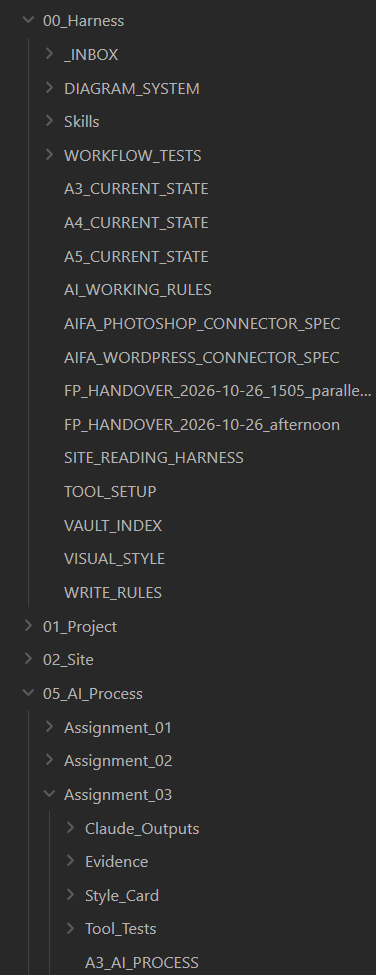
The whole project lives in one Obsidian vault. Every tool reads from it and writes back to it, so every claim on this site can be traced to a record.
How the Vault Is Organised
The whole project lives in one Obsidian vault on my computer. Every tool reads from it and writes back to it. Nothing depends on a chat remembering what happened, and every claim on this site can be traced to a record.
- The HarnessThe working rules, the current state of each stage, the skills and the tool setup. Every Claude session reads these before it starts work.
- The RecordsOne folder per stage, holding the exchange logs, where each decision is recorded as a numbered round; the registers that facts are checked against; and the workflow tests.
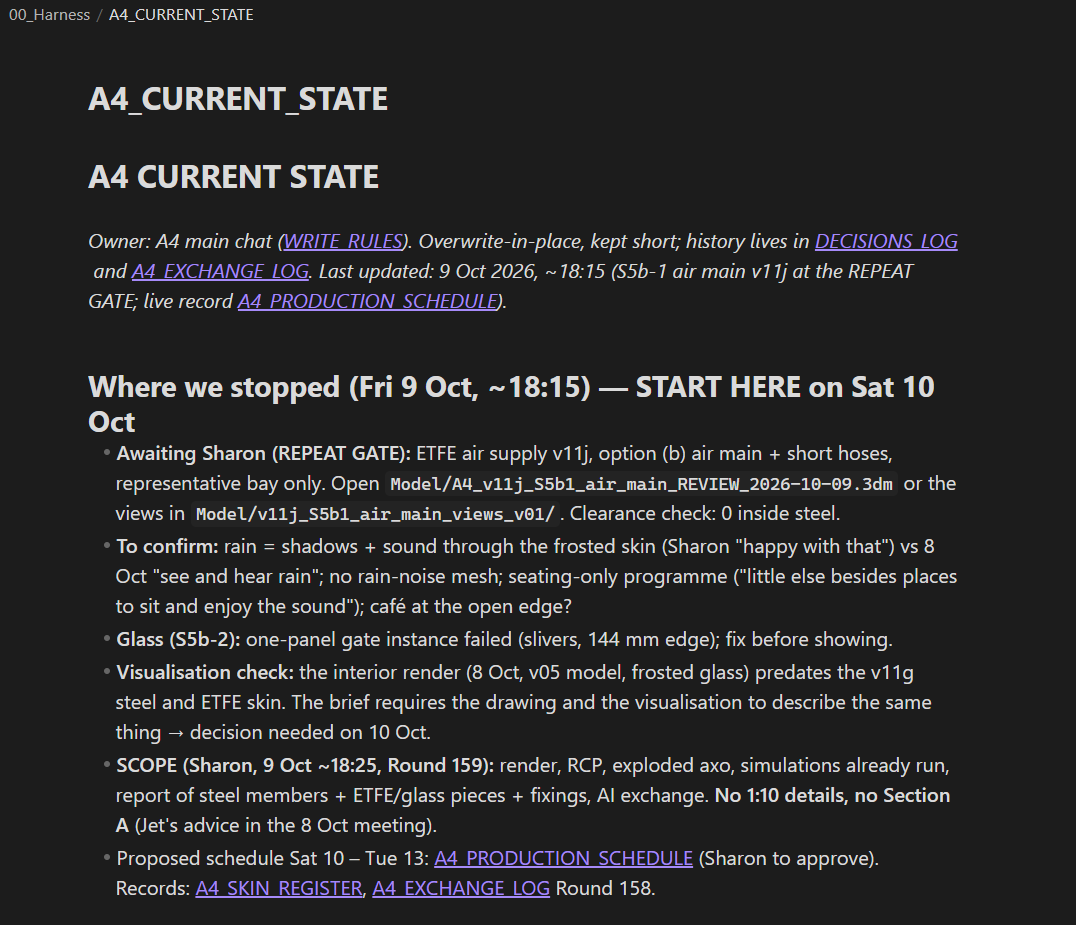
- Planning and Current StateAt the start of each stage, Claude read the brief and deliverables from the vault and drafted a schedule against my hard stops, which I approved; for the site reading and the canopy, it is kept in the vault. During the work Claude tracked what was left and warned me as each stop approached. At the end of each day it recorded where we stopped in the current-state file, and the next session started from there.
- Connector LogsEvery change made to this site is saved as a copy of the page before and after.
- Files Carried in by HandOutputs from ChatGPT and Midjourney were downloaded and saved into the vault by hand. Claude reads them from there, and this site is built from the vault through the connector.
The vault is what keeps the division of work honest. AI works from the records, and the records show what I decided.

06 · Rework
Rework, Counted
Where the record allows, each page shows how much correction an output needed, next to the output itself.
The Website: Testing the Canopy, As First Built and As Kept
Claude built this page on 16 Oct 2026 and changed it 32 times at my direction until 27 Oct. Every change went through the WordPress connector, which records my direction word for word and keeps a copy of the page before and after each change. I made no edits in WordPress myself.
| Visual design: type, colour, buttons, layout, logo | 14 |
| Corrections to what Claude built: images not loading, wrong crops, one caption | 4 |
| Content added at my request: the model view beside the render, hand-edit statements, notes, rework count | 4 |
| Wording and voice: assignment references removed, title case, presentation voice | 3 |
| Navigation and structure: menu, page order, links | 7 |
| Total changes at my direction | 32 |
Source: the WordPress connector log, 16 to 27 Oct 2026, one entry per change with my direction quoted.